Advertisements
Advertisements
प्रश्न
State Ohm’s law.
What is Ohm’s law?
Advertisements
उत्तर
According to Ohm’s law, at a constant temperature, the steady current ‘I’ flowing through a conductor is directly proportional to the potential difference ‘V’ between the two ends of the conductor.
I ∝ V
V = IR
संबंधित प्रश्न
Will current flow more easily through a thick wire or a thin wire of the same material, when connected to the same source? Why?
What is an Ohmic resistor?
Name the unit of electrical resistance and give its symbol.
The unit of electrical resistance is:
(a) ampere
(b) volt
(c) coulomb
(d) ohm
How much energy is consumed when a current of 5 amperes flows through the filament (or element) of a heater having resistance of 100 ohms for two hours? Express it in joules.
How would you connect two resistors in series? Draw a diagram. Calculate the total equivalent resistance.
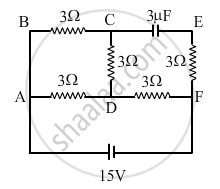
In the circuit shown in the figure, find the total resistance of the circuit and the current in the arm AD.
Define the following:
Coulomb
What is meant by the drift speed of free electrons?
What are non-ohmic conductors? Give one exmaple. Draw a current-voltage graph for a non-ohmic conductor.
Draw a neat diagram for the verification of Ohm’s law by voltmeter-ammeter method. By another diagram show the relation between p.d. and current.
State macroscopic form of Ohm’s law.
Define temperature coefficient of resistance.
An electronics hobbyist is building a radio which requires 150 Ω in her circuit, but she has only 220 Ω, 79 Ω, and 92 Ω resistors available. How can she connect the available resistors to get the desired value of resistance?
Which of the following is correct for V-I graph of a good conductor?
The slope of voltage (V) versus current (I) is called:

Assertion: The statement of Ohm’s law is K = IR.
Reason: V = IR is the equation which defines resistance.
A current of 0.8 A flows in a conductor of 40 Ω for 1 minute. The heat produced in the conductor will be ______.
The circuit depicted in the figure is employed for studying Ohm’s Law. Instead of using a standard resistor, a student opts for a glass tube filled with mercury (tube 1), connected to the circuit through two electrodes, E1 and E2. He records the readings of the ammeter and voltmeter, thereby calculating the resistance. The student repeats the experiment by substituting tube 1 with tube 2, where the same amount of mercury fills tube 2.
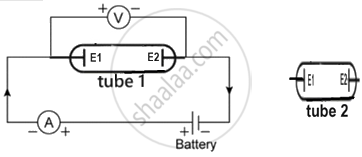
Neglecting internal resistance of the cell use (> or < or =) to compare:
- the resistance in both the cases.
- the voltmeter readings in both the cases.
- the specific resistance in both the cases.
A current of 3.2 mA flows through a conductor. If charge on an electron is −1.6 × 10⁻¹⁹ coulomb, find the number of electrons that will pass each second through the cross section of that conductor.
