Advertisements
Advertisements
प्रश्न
Will current flow more easily through a thick wire or a thin wire of the same material, when connected to the same source? Why?
Will current flow more easily through a thick wire or a thin wire of the same material when connected to the same source? Give reason for your answer.
Advertisements
उत्तर १
The current will flow more easily through thick wire. It is because the resistance of a
conductor is inversely proportional to its area of cross-section. If thicker the wire, less is resistance and hence more easily the current flows.
उत्तर २
Resistance (R) is inversely proportional to the area of the cross-section (A) of the
wire. So, thicker the wire, lower is the resistance of the wire and vice-versa.
Therefore, current can flow more easily through a thick wire than a thin wire.
`R = rho xx l/A`
`R ∝ 1/A`
उत्तर ३
The resistance of a conductor is inversely proportional to its area of cross-section, i.e. `R ∝ 1/A`. So as the conductor is a thick wire, its resistance decreases and current will flow easily through it, in comparison with a thin wire.
संबंधित प्रश्न
What will be the change in the current if the potential difference is kept constant and the resistance of the circuit is made four times?
- It will remain unchanged.
- It will become four times.
- It will become one-fourth.
- It will become half.
Find the resistance of a conductor if 0.24 A current is passing through it and a potential difference of 24 V is applied across it.
Write the formula of resistivity
State Ohm’s law and draw a neat labelled circuit diagram containing a battery, a key, a voltmeter, an ammeter, a rheostat and an unknown resistance to verify it.
What is the necessary condition for a conductor to obey Ohm’s law?
Which of the following is an ohmic resistance?
In an experiment of verification of Ohm’s law following observations are obtained.
|
Potential difference V (in volt) |
0.5 | 1.0 | 1.5 | 2.0 | 2.5 |
| current I (in ampere) | 0.2 | 0.4 | 0.6 | 0.8 | 1.0 |
Draw a V-I graph and use this graph to find:
- the potential difference V when the current I is 0.5 A,
- the current I when the potential difference V is 0.75 V,
- the resistance in a circuit.
A wire of resistance 3 ohm and length 10 cm is stretched to length 30 cm. Assuming that it has a uniform cross section, what will be its new resistance?
How would you connect two resistors in series? Draw a diagram. Calculate the total equivalent resistance.
A wire has a length of 2.0 m and a resistance of 5.0 Ω. Find the electric field existing inside the wire if it carries a current of 10 A.
How does an increase in the temperature affect the specific resistance of a semiconductor?
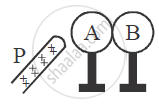
Two metallic spheres A and B kept on insulating stands are in contact with each other. A positively charged rod P is brought near the sphere A as shown in the figure. The two spheres are separated from each other, and the rod P is removed. What will be the nature of charges on spheres A and B?
Consider the sacle of voltmeter shown in the diagram and answer the following questions :

(a) What is the least count of the voltmeter?
(b) What is the reading shown by the voltmeter ?
(c) If the voltmeter is connected across a resistor of 20 `Omega` how much current is flowing through the resistor?
State the limitations of Ohm’s law.
State macroscopic form of Ohm’s law.
Resistance (R) in a conductor is best described as:
When two conductors at different electric potentials are joined by a metallic wire, in which direction do the electrons flow?
A resistor is connected in a circuit with a voltage of 12 V and a resistance of 24 Ω. What is the current flowing through the resistor?
