Advertisements
Advertisements
Question
Calculate the electric field in a copper wire of cross-sectional area 2.0 mm2 carrying a current of 1 A.
The resistivity of copper = 1.7 × 10⁻⁸ Ω m
Advertisements
Solution
Given:-
Area of cross-section, A = 2 × 10⁻⁶ m2
Current through the wire, i = 1 A
Resistivity of copper, ρ = 1.7 × 10⁻⁸ Ωm
Resistance of a wire,
\[R = \rho\frac{l}{A}\]
Also from Ohm's Law, voltage across a wire,
\[V = iR = \frac{i\rho l}{A}\]
The electric field of the wire,
\[E = \frac{V}{l}\]
Now:
`R = (fl)/A`
`= (1.7xx10^(-8)xxl)/(2xx10^-6)`
`V = iR = (1 xx1.7xx10^-8xxl)/(2xx10^-6)`
`E = (dV)/(dL) = V/l`
`= (1.7xx10^-8)/(2xx10^-6`
`= 1.7/2xx10^-2`
`= 17xx10^-3`
`= 8.5xx10^-3`mv/m.
APPEARS IN
RELATED QUESTIONS
Find the resistance of a conductor if 0.24 A current is passing through it and a potential difference of 24 V is applied across it.
Will current flow more easily through a thick wire or a thin wire of the same material, when connected to the same source? Why?
The relationship between the potential difference and the current in a conductor is stated in the form of a law.
- Name the law.
- What does the slope of V-I graph for a conductor represent?
- Name the material used for making the connecting wire.
What is Resistivity?
Find the expression for the resistivity of a material and state the SI unit of resistivity.
Keeping the p.d. constant, the resistance of a circuit is halved. The current will become:
(a) one-fourth
(b) four time
(c) half
(d) double
The graph between V and I for a conductor is a straight line passing through the origin.
What should remain constant in a statement of this law?
In an experiment of verification of Ohm’s law following observations are obtained.
|
Potential difference V (in volt) |
0.5 | 1.0 | 1.5 | 2.0 | 2.5 |
| current I (in ampere) | 0.2 | 0.4 | 0.6 | 0.8 | 1.0 |
Draw a V-I graph and use this graph to find:
- the potential difference V when the current I is 0.5 A,
- the current I when the potential difference V is 0.75 V,
- the resistance in a circuit.
A wire of resistance 9 ohm having length 30 cm is tripled on itself. What is its new resistance?
What length of copper wire of resistivity 1.7 × 10⁻⁸ Ω m and radius 1 mm is required so that its resistance is 2Ω?
In the circuit shown in the figure, find the total resistance of the circuit and the current in the arm AD.
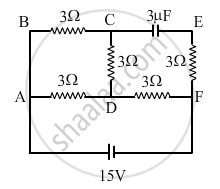
A wire connected to a power supply of 230 V has power dissipation P1. Suppose the wire is cut into two equal pieces and connected parallel to the same power supply. In this case, power dissipation is P2. The ratio of `"P"_2/"P"_1` is
State microscopic form of Ohm’s law.

Calculate the total resistance of the circuit and find the total current in the circuit.
The heat produced by a 100 w heater in 2 minute is equal to
How is electric current related to the potential difference across the terminals of a conductor?
Draw a labelled circuit diagram to verify this relationship.
A current of 0.8 A flows in a conductor of 40 Ω for 1 minute. The heat produced in the conductor will be ______.
Resistance (R) in a conductor is best described as:
If a current of 1 A flows through a conductor, then according to Ohm's Law, the resistance of the conductor is:
