Advertisements
Advertisements
Question
The filament of a bulb takes a current 100 mA when potential difference across it is 0.2 V. When the potential difference across it becomes 1.0 V, the current becomes 400 mA. Calculate the resistance of filament in each case and account for the difference.
Advertisements
Solution
According to Ohm's law,
V = IR
∴ R = `"V"/"I"`
`therefore "R"_1 = "V"_1/"I"_1`
= `0.2/0.1 = 2 Omega`
Similarly ,
`"R"_2 = "V"_2/"I"_2`
= `1/0.4`
= 2.5 Ω
Resistance of the wire increases with increase in temperature. So the difference arises because the temperature of the filament increased.
APPEARS IN
RELATED QUESTIONS
Name the unit of electrical resistance and give its symbol.
- Draw a V-I graph for a conductor obeying Ohm’s law.
- What does the slope of V–I graph for a conductor represent?
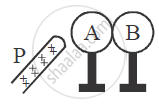
Two metallic spheres A and B kept on insulating stands are in contact with each other. A positively charged rod P is brought near the sphere A as shown in the figure. The two spheres are separated from each other, and the rod P is removed. What will be the nature of charges on spheres A and B?
The ratio of the potential difference to the current is known as ________.
A wire connected to a power supply of 230 V has power dissipation P1. Suppose the wire is cut into two equal pieces and connected parallel to the same power supply. In this case, power dissipation is P2. The ratio of `"P"_2/"P"_1` is
Define Current density.
The resistance of a resistor is reduced to half of its initial value. If other parameters of the electrical circuit remain unaltered, the amount of heat produced in the resistor will become ______.
The circuit depicted in the figure is employed for studying Ohm’s Law. Instead of using a standard resistor, a student opts for a glass tube filled with mercury (tube 1), connected to the circuit through two electrodes, E1 and E2. He records the readings of the ammeter and voltmeter, thereby calculating the resistance. The student repeats the experiment by substituting tube 1 with tube 2, where the same amount of mercury fills tube 2.
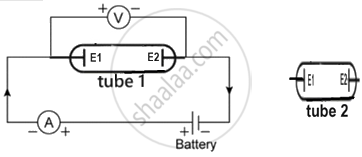
Neglecting internal resistance of the cell use (> or < or =) to compare:
- the resistance in both the cases.
- the voltmeter readings in both the cases.
- the specific resistance in both the cases.
