Advertisements
Advertisements
प्रश्न
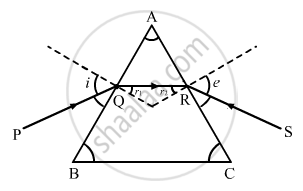
Figure shows a ray of light passing through a prism. If the refracted ray QR is parallel to the base BC, show that (i) r1 = r2 = A/2 and (ii) angle of minimum deviation, Dm = 2i − A.
Advertisements
उत्तर
(i) When QR is parallel to the base BC, we have: i = e
\[\Rightarrow r_1 = r_2 = r\]
We know that
\[r_1 + r_2 = A\]
\[ \Rightarrow r + r = A \]
\[ \therefore r = A/2\]
(ii) Also, we have:
A + D= i + e
Substituting, D = Dm and e = i
A + Dm= i + i
∴ Dm=2i - A
संबंधित प्रश्न
A ray of light passes through an equilateral glass prism such that the angle of incidence is equal to the angle of emergence and each of these angles is equal to 3/4 of angle of prism. Find the angle of deviation.
Two monochromatic rays of light are incident normally on the face AB of an isosceles right-angled prism ABC. The refractive indices of the glass prism for the two rays '1' and '2' are respectively 1.38 and 1.52. Trace the path of these rays after entering through the prism.

Describe an activity to show that the colours of white light splitted by a glass prism can be recombined to get white light by another identical glass prism. Also, draw a ray diagram to show the recombination of the spectrum of white light.
If a glass prism is dipped in water, its dispersive power ___________ .
The minimum deviations suffered by, yellow and violet beams passing through an equilateral transparent prism are 38.4°, 38.7° and 39.2° respectively. Calculate the dispersive power of the medium.
The deviation produced for violet, yellow and red lights for crown glass are 3.75°, 3.25° and 2.86° respectively. Calculate the dispersive power of the crown glass.
A narrow beam of monochromatic light, PQ, is incident normally on one face of an equiangular glass prism of refractive index 1.45. When the prism is immersed in a certain liquid, the ray makes a grazing emergence along the other face (See figure). Find the refractive index of this liquid. 
An equilateral glass prism has a refractive index 1.6 in the air. Calculate the angle of minimum deviation of the prism, when kept in a medium of refractive index `4sqrt(2)"/"5.`
For any prism, obtain a relation between the angle of the prism (A), the angle of minimum deviation (δm) and the refractive index of its material (μ or n).
What is meant by a thin prism?
