Advertisements
Advertisements
प्रश्न
In a conductor 6.25 × `10^16` electrons flow from its end A to B in 2 s. Find the current flowing through the conductor (e = 1.6 × `10^-19` C)
Advertisements
उत्तर
Number of electrons flowing through the conductor,
N = `6.25 × 10^16` electrons
Time taken, t = 2 s
Given, e = `1.6 × 10^-19` C
Let I be the current flowing through the conductor.
Then, I = `"ne"/t`
∴ I = `((6.25 xx 10^16)(1.6 xx10^-19))/2`
= ` 5 xx 10^-3`A
Or, I = 5 mA
Thus, 5 mA current flows from B to A.
APPEARS IN
संबंधित प्रश्न
If the potential difference across the ends of a conductor is 220 V and the resistance of the conductor is 44 Ω (ohm), then the current flowing through is _________.
- 0.2 A
- 0.5 A
- 2 A
- 5 A
What is an Ohmic resistor?
When a 12 V battery is connected across an unknown resistor, there is a current of 2.5 mA in the circuit. Calculate the value of the resistance of the resistor.
Calculate the effective resistance across AB?
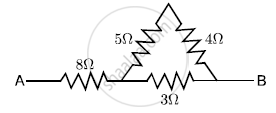
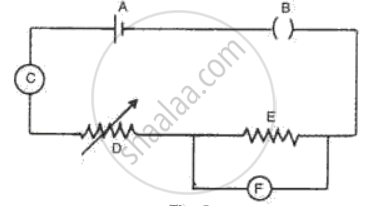
Fig. represents the circuit used for the verification of Ohm's law. Label the parts from A to F. state the function of each.
A wire connected to a power supply of 230 V has power dissipation P1. Suppose the wire is cut into two equal pieces and connected parallel to the same power supply. In this case, power dissipation is P2. The ratio of `"P"_2/"P"_1` is
Explain the equivalent resistance of a series resistor network.
A metal rod of length 10 cm and a rectangular cross-section of 1 cm × `1/2` cm is connected to a battery across opposite faces. The resistance will be ______.
Two conductors are made of the same material and have the same length. Conductor A is a solid wire of diameter 1 mm. Conductor B is a hollow tube of outer diameter 2 mm and inner diameter 1 mm. Find the ratio of resistance RA to RB.
If the voltage across a conductor is increased while its temperature remains unchanged, what happens to the current flowing through it?
