Advertisements
Advertisements
प्रश्न
State microscopic form of Ohm’s law.
Advertisements
उत्तर
Current density J at a point in a conductor is the amount of current flowing per unit area of the conductor around that point provided the area is held in a direction normal to the current.
J = `I/"A"`
Drift velocity, `"V"_"d" = "eE"/"m" tau`
I = `"neAV"_"d" = "neA" ("eA"/"m") tau ...["J" = "I"/"A"; sigma = ("ne"^2 tau)/"m"]`
`"I"/"A" = (("ne"^2tau)/"m")`E
J = σE
APPEARS IN
संबंधित प्रश्न
The relationship between the potential difference and the current in a conductor is stated in the form of a law.
- Name the law.
- What does the slope of V-I graph for a conductor represent?
- Name the material used for making the connecting wire.
When a 12 V battery is connected across an unknown resistor, there is a current of 2.5 mA in the circuit. Calculate the value of the resistance of the resistor.
In an experiment of verification of Ohm’s law following observations are obtained.
|
Potential difference V (in volt) |
0.5 | 1.0 | 1.5 | 2.0 | 2.5 |
| current I (in ampere) | 0.2 | 0.4 | 0.6 | 0.8 | 1.0 |
Draw a V-I graph and use this graph to find:
- the potential difference V when the current I is 0.5 A,
- the current I when the potential difference V is 0.75 V,
- the resistance in a circuit.
Tick(✓) the correct choice in the following:
Ohm's law is applicable to
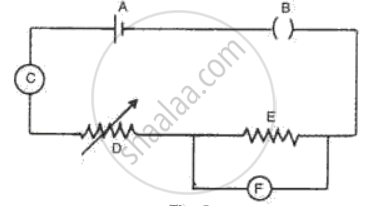
Fig. represents the circuit used for the verification of Ohm's law. Label the parts from A to F. state the function of each.
What is non ohmic device?
Assertion: The statement of Ohm’s law is K = IR.
Reason: V = IR is the equation which defines resistance.
State Ohm’s law? How can it be verified experimentally? Does it hold good under all conditions? Comment.
Consider a current carrying wire (current I) in the shape of a circle. Note that as the current progresses along the wire, the direction of j (current density) changes in an exact manner, while the current I remain unaffected. The agent that is essentially responsible for is ______.
If the voltage across a conductor is increased while its temperature remains unchanged, what happens to the current flowing through it?
