Advertisements
Advertisements
प्रश्न
A student carries out an experiment and plots the V-I graph of three samples of nichrome wire with resistances R1, R2 and R3 respectively. Which of the following is hue?

विकल्प
R1 = R2 = R3
R1 > R2 > R3
R3 > R2 > R1
R2 > R3 > R1
Advertisements
उत्तर
R3 > R2 > R1
Explanation:
Current is inversely proportional to the resistance for the same potential. So higher resistance would allow less current to pass through its which is shown by R3 as I3 < I2 < I1.
∴ R3 > R2 > R1
APPEARS IN
संबंधित प्रश्न
An electrical bulb is marked 200V, 100W. Calculate the electrical resistance of its filament. If five such
bulbs are connected in series to a 200V supply, how much current will flow through them?
Find the expression for the resistivity of a material and state the SI unit of resistivity.
An electric bulb draws 1.2 A current at 6.0 V. Find the resistance of filament of bulb while glowing.
How would you connect two resistors in series? Draw a diagram. Calculate the total equivalent resistance.
Show by a diagram how two resistors R1 and R2 are joined in parallel. Obtain an expression for the total resistance of the combination.
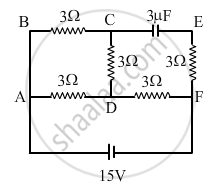
In the circuit shown in the figure, find the total resistance of the circuit and the current in the arm AD.
Calculate the electric field in a copper wire of cross-sectional area 2.0 mm2 carrying a current of 1 A.
The resistivity of copper = 1.7 × 10⁻⁸ Ω m
A wire has a length of 2.0 m and a resistance of 5.0 Ω. Find the electric field existing inside the wire if it carries a current of 10 A.
- Name and state the law which relates the potential difference and current in a conductor.
- What is the necessary condition for a conductor to obey the law named above in part (a) ?
Define ampere and volt with respect to Ohm’s law.
