English

A Student Made an Electric Circuit Shown Here to Measure the Current Through Two Lamps. Are the Lamps in Series Or Parallel? (A) Are the Lamps in Series Or Parallel? (B) the Student Has Made a Mistake in this Circuit. What is the Mistake? (C) Draw a Circuit Diagram to Show the Correct Way to Connect the Circuit. Use the Proper Circuit Symbols in Your Diagram. - Science

Advertisements
Advertisements

Question

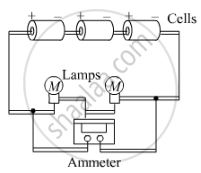
A student made an electric circuit shown here to measure the current through two lamps.

Are the lamps in series or parallel?  

(a) Are the lamps in series or parallel?
(b) The student has made a mistake in this circuit. What is the mistake?
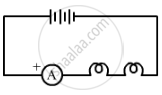
(c) Draw a circuit diagram to show the correct way to connect the circuit. Use the proper circuit symbols in your diagram. 
Advertisements

Solution

(a) The lamps are connected in series.
(b) The student has connected the ammeter in parallel with the lamps. It should be connected in series.
(c) The correct diagram that shows how to connect the circuit: 
shaalaa.com
  Is there an error in this question or solution?
Chapter 1: Electricity - Exercise 2

APPEARS IN

Lakhmir Singh Physics (Science) [English] Class 10
Chapter 1 Electricity
Exercise 2 | Q 32

Video TutorialsVIEW ALL [1]

RELATED QUESTIONS

Fill in the blank:

To increase the effective resistance in a circuit the resistors are connected in _____________.


The circuit diagram given below shows the combination of three resistors R1, R2 and R3


Find :
(i) total resistance of the circuit.
(ii) total current flowing in the circuit.
(iii) the potential difference across R1.


In the circuit diagram given below five resistances of 10 Ω, 40 Ω, 30 Ω, 20 Ω, and 60 Ω are connected as shown to a 12 V battery. 


Calculate:
(a) total resistance in the circuit. 

(b) total current flowing in the circuit.


In the circuit shown below, the voltmeter reads 10 V. 


(a) What is the combined resistance?
(b) What current flows?
(c) What is the p.d. across 2 Ω resistor?
(d) What is the p.d. across 3 Ω resistor?


(a) With the help of a circuit diagram, obtain the relation for the equivalent resistance of two resistances connected in parallel.
(b) In the circuit diagram shown below, find:

(i) Total resistance.
(ii) Current shown by the ammeter 


Which is the better way to connect lights and other electrical appliances in domestic wiring: series circuits or parallel circuits? why?


State the S.I. unit of current.


If a charge of 420 C flows through a conducting wire in 5 minutes what is the value of the current?


Where is the main fuse in a house circuit connected?

An electric bulb is rated at 220 V, 100 W. What is its resistance? What maximum current can be passed through it?

The marking on an electric bulb reads; 200 V, 60 W. What does it mean?

How does an alternating current differ from the direct current?

Two cells each having an e.m.f. of 2 V and an internal resistance of 2Ω are
connected (a) In series, and ( b) In para 1le l as shown in fig. . What is the
current flowing through the cir cu it in each_ case?


Fig.  shows a 3 pin plug with the cover removed. The electric cable
connected to the plug contains 3 wires with colour coded insulation namely brown, blue and green.

  1. Identify each of the colour coded wires by stating to which of the
    terminals A, B or C in the diagram they should be connected.
  2. Identify the terminal through which no current passes in normal
    circumstances.
  3. What is the purpose of the earthed wire connected to an electric
    appliance like an electric heater? Describe how it works.

An auto lamp is joined to a battery of e.m.f. 4 V and internal resistance 2.5Ω. A steady current of 0.5 A flows through the circuit. Calculate the
(a) Total energy provided by battery in 10 minutes,
(b) Heat dissipated in the bulb in 10 minutes.


Tick (✓) the correct choice among the following :

Which of the following changes would enable a millimeter to be used as a
direct current ammeter reading upto 1 A?


Tick (✓) the correct choice among the following :

There are 500 turns and 2000 turns in the primary and secondary coil of a
transformer respectively. If th e output voltage is 1000 V, how large is the
input voltage?


An electrical appliance is rated at 1000 KVA, 220V. If the appliance is operated for 2 hours, calculate the energy consumed by the appliance in: (i) kWh (ii) joule.


Coulomb is the SI unit of ____________.


Share
Notifications

Englishहिंदीमराठी


      Forgot password?
Use app×