Advertisements
Advertisements
Question
If the amount of electric charge passing through a conductor in 10 minutes is 300 C, the current flowing is:
(a) 30 A
(b) 0.3 A
(c) 0.5 A
(d) 5 A
Advertisements
Solution
0.5 A
APPEARS IN
RELATED QUESTIONS
Which of the two is connected in series : ammeter or voltmeter?
Fill in the folloing blank with suitable words:
Current is measured in ............... using an ............... placed in ............... in a circuit.
Draw a circuit diagram showing two electric lamps connected in parallel together with a cell and a switch that works both lamps. Mark an â’¶ on your diagram to show where an ammeter should be placed to measure the current.
Which effect of current is utilised in the working of an electric fuse?
Name two devices which work on the heating effect of electric current.
A switch must be connected in ______.
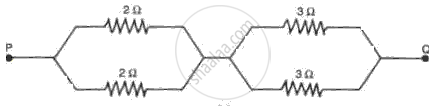
Find the effective resistance in the following circuit diagrams (Fig.):
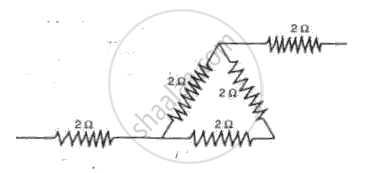
Find the effective resistance in the following circuit diagrams (Fig.):
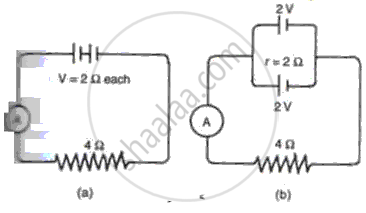
Two cells each having an e.m.f. of 2 V and an internal resistance of 2Ω are
connected (a) In series, and ( b) In para 1le l as shown in fig. . What is the
current flowing through the cir cu it in each_ case?
60 joules of heat was dissipated in a resistor when 20 C flowed for 5 s. Calculate:
(a) P.d. across the resistor,
(b) Resistance of the resistor, and
(c) Average power dissipated in the resistor.
Fig . shows the core of a transformer and i ts input and output connections
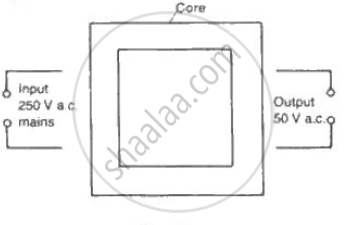
State the material used for the core and describe th e structure of the core.
(a) Use the values given in the diagram to calculate the turns ratio for the transformer and connections, labeling all parts of the diagram .
(b) If a current of 2 A is taken from th e output, calculate th e current in the input circuit (Assume the transformer to be ideal ).
Calculate the current through a 60 W lamp rated 250 V. If the line voltage falls to 200 V, how is power consumed by the bulb affected?
Fill in the blank :
1 mA = ............................. A.
MCB is used to protect household electrical appliances.
- What is meant by electric current?
- Name and define its unit.
- Which instrument is used to measure the electric current? How should it be connected in a circuit?
Electric current passes through a metallic conductor due to the movement of ______.
In metallic conductors, the charge carriers responsible for producing electric current are:
