Advertisements
Advertisements
प्रश्न
If the amount of electric charge passing through a conductor in 10 minutes is 300 C, the current flowing is:
(a) 30 A
(b) 0.3 A
(c) 0.5 A
(d) 5 A
Advertisements
उत्तर
0.5 A
APPEARS IN
संबंधित प्रश्न
Calculate the number of electrons constituting one coulomb of charge.
What is the current in a circuit if the charge passing each point is 20 C in 40 s?
Write down the formula which relates electric charge, time and electric current
One coulomb of charge flows through any cross-section of a conductor in 1 second. What is the current flowing through the conductor?
State the factors on which the strength of electric current flowing in a given conductor depends.
Using the circuit given below, state which of the following statement is correct?
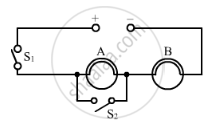
(a) When S1 and S2 are closed, lamps A and B are lit.22
(b) With S1 open and S2 closed, A is lit and B is not lit.
(c) With S2 open and S1 closed A and B are lit.
(d) With S1 closed and S2 open, lamp A remains lit even if lamp B gets fused.
Which effect of current is utilised in an electric light bulb?
Tell the odd one out. Give a proper explanation.
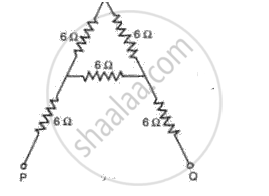
Find the effective resistance in the following circuit diagrams (Fig.):
An electric kettle has a heating element which is rated at 2 kW when connected to a 250 V electric supply. Calculate the
(a) Current which flows in the element when it is connected to a 250 V supply,
(b) Resistance of the filament,
(c) Heat produced in 1 minute by the element,
(d) Cost of running the kettle for 10 minutes a day for 30 days of the month, at the rate of Rs. 3.00 per unit.
Three heaters each rated 250 W, 100 V are connected in parallel to a 100 V supply. Calculate :
The total current taken from the supply
A battery of e.m.f. 15 V and internal resistance 2 Ω is connected to two resistors of resistances 4 ohm and 6 ohm joined (a) in series. Find in each case the electrical energy spent per minute in 6 Ω resistor.
My mother was operating washing machine on Sunday morning. Suddenly, she saw a spark coming out of the electric board and the electric current in the house failed. An electrician was called to look into the matter. What should he have noticed.
Small amounts of electrical current are measured in milliampere (mA). How many milliampere are there in 0.25 A ?
Coulomb is the SI unit of ____________.
A current of 1 A is drawn by a filament of an electric bulb. Number of electrons passing through a cross section of the filament in 16 seconds would be roughly
Unit of electric power may also be expressed as
