Advertisements
Advertisements
प्रश्न
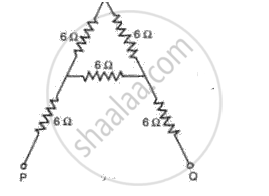
Find the effective resistance in the following circuit diagrams (Fig.):
Advertisements
उत्तर
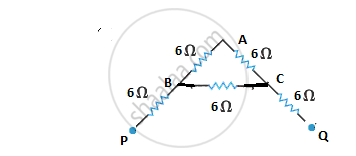
In the given network, between B and C the series combination
of two 6 Ω resistors is connected in parallel with the third 6Ω resistor.
`1/"R"_"equivalent" = 1/(6 +6) + 1/6 = 1/12 + 1/6 = 3/12 = 1/4`
`"R"_"equivalent" = 4 Omega`
Now, between P and Q, two 6 Ω resistors and 4Ω resistor are connected in series.
:. total resistance between P and Q is:
`"R"_"total"` = 6 + 6 + 4 = 16Ω
APPEARS IN
संबंधित प्रश्न
An electrician has wired a house in such a way that if a lamp gets fused in one room of the house, all the lamps in other rooms of the house stop working. What is the defect in the wiring?
How does the heat H produced by a current passing through a fixed resistance wire depend on magnitude of current I?
Distinguish between an open and a closed circuit.
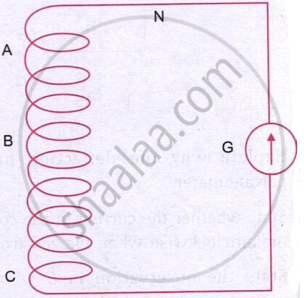
A strong short bar magnet is dropped into a solenoid connected to a
galvanometer as shown in fig. The galvanometer shows a deflection to the left when the current in the coil as seen from above is counter clockwise. Which one of the following shows the correct deflection of the galvanometer when the magnet is at posi tions A, Band C.
A current of 0.2 A flows through a wire whose ends are at a potential difference of 15 V. Calculate:
(i) The resistance of the wire, and
(ii) The heat energy produced in 1 minute.
An electrical appliance is rated at 1000 KVA, 220V. If the appliance is operated for 2 hours, calculate the energy consumed by the appliance in: (i) kWh (ii) joule.
An electric bulb is marked 100 W, 250 V. How much current will the bulb draw if connected to a 250 V supply?
A charge of 400C flows through a conductor for 13 minutes and 20 seconds. Find the magnitude of the current flowing through the conductor.
The direction of Direct Current (DC) is characterized as:
