Advertisements
Advertisements
Question
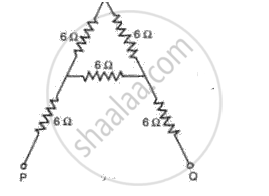
Find the effective resistance in the following circuit diagrams (Fig.):
Advertisements
Solution
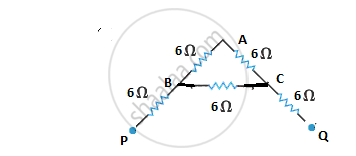
In the given network, between B and C the series combination
of two 6 Ω resistors is connected in parallel with the third 6Ω resistor.
`1/"R"_"equivalent" = 1/(6 +6) + 1/6 = 1/12 + 1/6 = 3/12 = 1/4`
`"R"_"equivalent" = 4 Omega`
Now, between P and Q, two 6 Ω resistors and 4Ω resistor are connected in series.
:. total resistance between P and Q is:
`"R"_"total"` = 6 + 6 + 4 = 16Ω
APPEARS IN
RELATED QUESTIONS
By what name is the physical quantity coulomb/second called?
In 10 s, charge of 25 C leaves a battery, and 200 J of energy are delivered to an outside circuit a result.
What current flows from the battery?
In the circuit diagram given below five resistances of 10 Ω, 40 Ω, 30 Ω, 20 Ω, and 60 Ω are connected as shown to a 12 V battery.
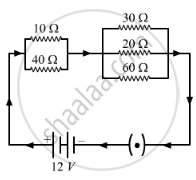
Calculate:
(a) total resistance in the circuit.
(b) total current flowing in the circuit.
An electric bulb is rated as 10 W, 220 V. How many of these bulbs can be connected in parallel across the two wires of 220 V supply line if the maximum current which can be drawn is 5 A?
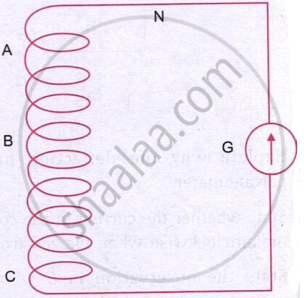
A strong short bar magnet is dropped into a solenoid connected to a
galvanometer as shown in fig. The galvanometer shows a deflection to the left when the current in the coil as seen from above is counter clockwise. Which one of the following shows the correct deflection of the galvanometer when the magnet is at posi tions A, Band C.
A battery of e.m.f. 15 V and internal resistance 2 Ω is connected to two resistors of resistances 4 ohm and 6 ohm joined (a) in series. Find in each case the electrical energy spent per minute in 6 Ω resistor.
How is direction of current related to the direction of flow of electrons?
Electric current flows through a circuit only when:
