Advertisements
Advertisements
प्रश्न
What is the current in a circuit if the charge passing each point is 20 C in 40 s?
Advertisements
उत्तर
Here:
Charge, Q = 20 C
Time, t = 40 s
We know that, I = Q/t.
So:
I = 20/40 = 0.5 A
Therefore, the electric current flowing through the circuit is 0.5 A.
APPEARS IN
संबंधित प्रश्न
Draw the electrical symbols of the following components and state its use:
Ammeter.
The work done in moving a unit charge across two points in an electric circuit is a measure of ______.
What actually travels through the wires when you switch on a light?
What is the unit of electric current?
A p.d. of 6 V is applied to two resistors of 3 Ω and 6 Ω connected in parallel. Calculate:
(a) the combined resistance
(b) the current flowing in the main circuit
(c) the current flowing in the 3 Ω resistor.
A battery and three lamps are connected as shown:
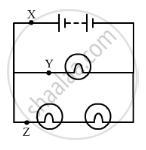
Which of the following statements about the currents at X, Y and Z is correct?
(a) The current at Z is greater than that at Y.
(b) The current at Y is greater than that at Z.
(c) The current at X equals the current at Y.
(d) The current at X equals the current at Z.
A given wire of resistance 1 Ω is stretched to double its length. What will be its new resistance?
The following table shows the current in Amperes and potential differences in Volts.
- Find the average resistance.
- What will be the nature of the graph between the current and potential difference? (Do not draw a graph.)
- Which law will the graph prove? Explain the law.
| V (volts) | I (amp) |
| 4 | 9 |
| 5 | 11.25 |
| 6 | 13.5 |
Match the pairs.
| ‘A’ Group | ‘B’ Group |
| 1. Free electrons | a. V/R |
| 2. Current | b. Increases the resistance in the circuit |
| 3. Resistivity | c. Weakly attached |
| 4. Resistances in series | d. VA/LI |
A fuse is a short piece of wire of high ______ and low ______.
State whether the current is a scalar or vector?
Complete the following:
1 kWh = _________ J
An electric bulb is rated '100 W, 250 V'. How much current will the bulb draw if connected to a 250 V supply?
A bulb marked 12 V, 24 W operates on a 12 V battery for 20 minutes. Calculate:
- The current flowing through it, and
- The energy consumed.
Answer the following question.
What is the function of a galvanometer in a circuit?
Explain, why the potential difference across the terminals of a cell is more when the cell is not in use than it is when the cell is being used.
Problems for practice:
If 5A current flows through a circuit, then convert the current in terms of microampere?
