Advertisements
Advertisements
प्रश्न
State the factors on which the strength of electric current flowing in a given conductor depends.
Advertisements
उत्तर
The strength of the electric current flowing in a given conductor depends on two factors:
1) The potential difference across the ends of the conductor
2) The resistance of the conductor
APPEARS IN
संबंधित प्रश्न
In which direction does conventional current flow around a circuit?
How many electrons are flowing per second past a point in a circuit in which there is a current of 5 amp?
An electric circuit consisting of a 0.5 m long nichrome wire XY, an ammeter, a voltmeter, four cells of 1.5 V each and a plug key was set up.
Following graph was plotted between V and I values:
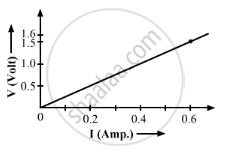
What would be the values of `V/I` rations when the potential difference is 0.8 V, 1.2 V and 1.6 V respectively?
What conclusion do you draw from these values?
What is the resistance of the wire?
An electric bulb of resistance 20 Ω and a resistance wire of 4 Ω are connected in series with a 6 V battery.
Draw the circuit diagram, and calculate:
(a) total resistance of the circuit.
(b) current through the circuit.
(c) potential difference across the electric bulb.
(d) potential difference across the resistance wire.
A battery and three lamps are connected as shown:
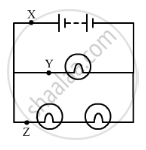
Which of the following statements about the currents at X, Y and Z is correct?
(a) The current at Z is greater than that at Y.
(b) The current at Y is greater than that at Z.
(c) The current at X equals the current at Y.
(d) The current at X equals the current at Z.
What happens to the other bulbs in a parallel circuit if one bulb blows off?
Ten bulbs are connected in a series circuit to a power supply line. Ten identical bulbs are connected in a parallel circuit to an identical power supply line.
(b) In which circuit, if one bulbs be brighter?
Define the term resistivity.
An electric kettle has a heating element which is rated at 2 kW when connected to a 250 V electric supply. Calculate the
(a) Current which flows in the element when it is connected to a 250 V supply,
(b) Resistance of the filament,
(c) Heat produced in 1 minute by the element,
(d) Cost of running the kettle for 10 minutes a day for 30 days of the month, at the rate of Rs. 3.00 per unit.
An electric bulb is rated 250 W, 230 V.
- the energy consumed in one hour, and
- the time in which the bulb will consume 1.0 kWh energy when connected to 230 V mains.
A battery of e.m.f. 15 V and internal resistance 2 Ω is connected to two resistors of resistances 4 ohm and 6 ohm joined (a) in series. Find in each case the electrical energy spent per minute in 6 Ω resistor.
Answer the following question.
What is the function of a galvanometer in a circuit?
State expression for Cells connected in series.
What is meant by internal resistance of a cell?
- What is meant by electric current?
- Name and define its unit.
- Which instrument is used to measure the electric current? How should it be connected in a circuit?
Define the following:
Conventional current
