Advertisements
Advertisements
Question
Advertisements
Solution
APPEARS IN
RELATED QUESTIONS
One coulomb charge is equivalent to the charge contained in:
(a) 2.6 × 10¹⁹ electrons
(b) 6.2 × 10¹⁹ electrons
(c) 2.65 × 10¹⁸ electrons
(d) 6.25 × 10¹⁸ electrons
Which of the two is connected in series : ammeter or voltmeter?
Compare how an ammeter and a voltmeter are connected in a circuit.
Consider the circuit given below when A, B and C are three identical light bulbs of constant resistance. 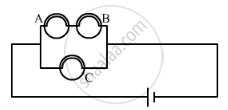
(a) List the bulbs in order of increasing brightness.
(b) If C burns out, what will be the brightness of A now compared with before?
(c) If B burns out instead, what will be the brightness of A and C compared with before?
Define the following:
Super conductors
A current of 0.2 A flows through a wire whose ends are at a potential difference of 15 V. Calculate:
(i) The resistance of the wire, and
(ii) The heat energy produced in 1 minute.
At the time of short circuit, the electric current in the circuit ______.
State the condition when it is advantageous to connect cells in series.
An electric bulb is marked 100 W, 250 V. How much current will the bulb draw if connected to a 250 V supply?
