Advertisements
Advertisements
Question
At the time of short circuit, the electric current in the circuit ______.
Options
vary continuously
does not change.
reduces substantially
increases heavily
Advertisements
Solution
At the time of the short circuit, the electric current in the circuit increases heavily.
Explanation:
A short circuit occurs when an electric current escapes the normal load via a low-resistance pathway (usually caused by direct contact between the live and neutral wires). Ohm’s Law (I = V/R) states that current (I) is inversely proportional to resistance. Short circuits lower resistance to near-zero levels, resulting in a sudden and significant rise in current. This quick surge can generate a lot of heat, which could start a fire or damage electrical components.
APPEARS IN
RELATED QUESTIONS
Three 2 V cells are connected in series and used as a battery in a circuit.
How many joules of electrical energy does 1 C gain on passing through (i) one cell (ii) all three cells?
What actually travels through the wires when you switch on a light?
What happens to the other bulbs in a parallel circuit if one bulb blows off?
The rating of a fuse connected in the lighting circuit is ______.
Fig . shows the core of a transformer and i ts input and output connections
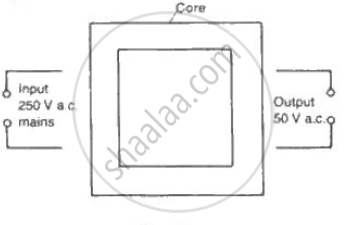
State the material used for the core and describe th e structure of the core.
(a) Use the values given in the diagram to calculate the turns ratio for the transformer and connections, labeling all parts of the diagram .
(b) If a current of 2 A is taken from th e output, calculate th e current in the input circuit (Assume the transformer to be ideal ).
Name any two devices, which are working on the heating effect of the electric current.
Define the following:
Conventional current
