Advertisements
Advertisements
Question
Consider the circuit given below when A, B and C are three identical light bulbs of constant resistance. 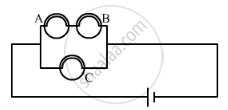
(a) List the bulbs in order of increasing brightness.
(b) If C burns out, what will be the brightness of A now compared with before?
(c) If B burns out instead, what will be the brightness of A and C compared with before?
Advertisements
Solution
(a) The brightness of A and B is the same. C is brighter since in A and B, the same amount of current flows but the voltage gets divided into two parts. Therefore, bulbs A and B glow dimmer.
(b) The brightness of A will remain the same because voltage distribution will have no effect if bulb C burns out.
(c) Bulb A will get switched off because the current will not flow to it if bulb B burns out since they are in a series circuit. The brightness of C will remain the same because the same current will continuously flow through bulb C.
APPEARS IN
RELATED QUESTIONS
Calculate the number of electrons constituting one coulomb of charge.
One coulomb charge is equivalent to the charge contained in:
(a) 2.6 × 10¹⁹ electrons
(b) 6.2 × 10¹⁹ electrons
(c) 2.65 × 10¹⁸ electrons
(d) 6.25 × 10¹⁸ electrons
<p> Define the unit of electric current (or Define ampere).
Which unit could be used to measure current?
(a) Watt
(b) Coulomb
(c) Volt
(d) Ampere
An electric bulb of resistance 20 Ω and a resistance wire of 4 Ω are connected in series with a 6 V battery.
Draw the circuit diagram, and calculate:
(a) total resistance of the circuit.
(b) current through the circuit.
(c) potential difference across the electric bulb.
(d) potential difference across the resistance wire.
An electric current flowing in a wire creates ______ around the wire.
The following appliances are to be used on 240 V supply. Calculate the current used by each and say which fuse, 2 amp, 5 amp or 13 amp should be incorporated with each, (i) A television rated at 150 W, (ii) An electric iron rated at 750 W, (iii) An immersion heater rated at 3000 W, (iv) A hair dryer rated at 500 W. How much will it cost to run the television set for 100 days for an average of 4 hours a day at 60 paise per unit?
What is the criteria for selecting a fuse wire?
A 3 pin mains plug is fitted to the lead for a 1 kW electric kettle to be used on a 250 V A.C. supply. Which of the following statements is NOT correct?
(a) A 13 A fuse is the most appropriate value to use.
(b) The brown wire should be connected to the live side of the mains.
A wire is passed through a piece of cardboard as shown in fig .. An electric current flows vertically down the wire and then flows back up. The two sections of the write are observed to repel each other.
(a) Wi th the aid of a diagram, describe how you would plot the magnetic field lines on the card .
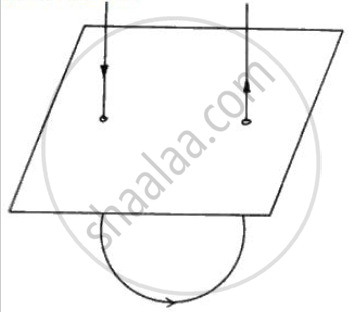
(b) Sketch the magnetic field patterns around both the sections of the wire. Use your sketch to explain why the two sections repel each other.
(c) The repulsive force between the two sections is small. What changes could be made to increase it?
A current of 0.2 A flows through a wire whose ends are at a potential difference of 15 V. Calculate:
(i) The resistance of the wire, and
(ii) The heat energy produced in 1 minute.
At the time of short circuit, the electric current in the circuit ______.
A current of 2A passing through the conductor produces 80 J of heat in 10 seconds. The resistance of the conductor is ______.
Assertion (A): Electric current will not flow between two charged bodies when connected if their charges are the same.
Reason (R): Current is the rate of flow of charge.
Common sources of Direct Current (DC) are:
