Advertisements
Advertisements
Question
The p.d. across a 3 Ω resistor is 6 V. The current flowing in the resistor will be:
(a) `1/2A`
(b) 1 A
(c) 2 A
(d) 6 A
Advertisements
Solution
(c) 2 A
If the p.d. across a 3 Ω resistor is 6 V, the current flowing in the resistor will be 2 A as current (I) is given by the equation, I = V (Voltage) / R (Resistance).
or I = V/R
I = 6 V/3 Ω
I = 2 A
APPEARS IN
RELATED QUESTIONS
The SI unit of charge is volt.
Compare how an ammeter and a voltmeter are connected in a circuit.
What is an electric current?
If the charge on an electron is 1.6 × 10⁻¹⁹ coulombs, how many electrons should pass through a conductor in 1 second to constitute 1 ampere current?
The figure given below shows an electric circuit in which current flows from a 6 V battery through two resistors.
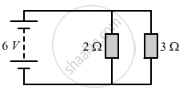
- Are the resistors connected in series with each other or in parallel?
- For each resistors, state the p.d. across it.
- The current flowing from the battery is shared between the two resistors. Which resistor will have bigger share of the current?
- Calculate the effective resistance of the two resistors.
- Calculate the current that flows from the battery.
An electrician has wired a house in such a way that if a lamp gets fused in one room of the house, all the lamps in other rooms of the house stop working. What is the defect in the wiring?
The lamps in a house hold circuit are connected in parallel because:
(a) this way they required less current
(b) if one lamp fails the others remain lit
(c) this way they require less power
(d) if one lamp fails the other also fail
An electric bulb is rated as 10 W, 220 V. How many of these bulbs can be connected in parallel across the two wires of 220 V supply line if the maximum current which can be drawn is 5 A?
Define the term resistivity.
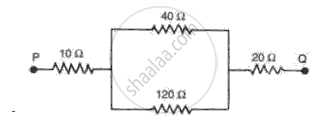
Find the effective resistance in the following circuit diagrams (Fig.):
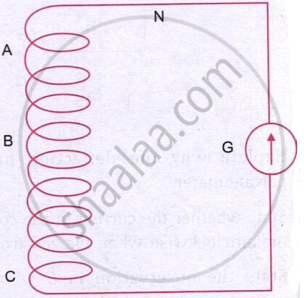
A strong short bar magnet is dropped into a solenoid connected to a
galvanometer as shown in fig. The galvanometer shows a deflection to the left when the current in the coil as seen from above is counter clockwise. Which one of the following shows the correct deflection of the galvanometer when the magnet is at posi tions A, Band C.
Tick (✓) the correct choice among the following :
There are 500 turns and 2000 turns in the primary and secondary coil of a
transformer respectively. If th e output voltage is 1000 V, how large is the
input voltage?
How is direction of current related to the direction of flow of electrons?
Water : pipe :: Electric current : ______.
Define the following:
Conventional current
In a vacuum, the particles that can act as charge carriers are:
A switch in an electric circuit is used to:
