Advertisements
Advertisements
Question
What is an electric current?
Advertisements
Solution
An electric current is the flow of electric charge called electrons in a conductor and its magnitude is the amount of electric charge passing through a given point of the conductor in one second.
APPEARS IN
RELATED QUESTIONS
Why are metals good conductors of electricity whereas glass is a bad conductor of electricity? Give reason?
The work done in moving a unit charge across two points in an electric circuit is a measure of ______.
Three 2 V cells are connected in series and used as a battery in a circuit.
- What is the p.d. at the terminals of the battery?
- How many joules of electrical energy does 1 C gain on passing through
- one cell
- all three cells?
If 20 C of charge pass a point in a circuit in 1 s, what current is flowing?
If the amount of electric charge passing through a conductor in 10 minutes is 300 C, the current flowing is:
(a) 30 A
(b) 0.3 A
(c) 0.5 A
(d) 5 A
Which is the better way to connect lights and other electrical appliances in domestic wiring: series circuits or parallel circuits? why?
The lamps in a house hold circuit are connected in parallel because:
(a) this way they required less current
(b) if one lamp fails the others remain lit
(c) this way they require less power
(d) if one lamp fails the other also fail
What is international convention of colour coding in a cable?
An electric oven is rated as 1.5 kW, 250 V. If it is connected to a 250 V mains, calculate the
(a) Current drawn,
(b) Energy consumed in 20 hours,
(c) Cost of energy consumed in 20 hours at the rate of Re. 1 per unit.
Complete the following:
1 kWh = _________ J
A bulb marked 12 V, 24 W operates on a 12 V battery for 20 minutes. Calculate:
- The current flowing through it, and
- The energy consumed.
A geyser is rated 1500 W, 250 V. This geyser is connected to 250 V mains. Calculate:
- The current drawn,
- The energy consumed in 50 hours, and
- The cost of energy consumed at ₹ 4.20 per kWh.
State whether the following statement is True or False:
The SI unit of charge is the coulomb.
Answer the following question.
An electric lamp of resistance 20 Ω and a conductor of resistance 4 0 are connected to a 6 V battery as shown in the circuit. Calculate: 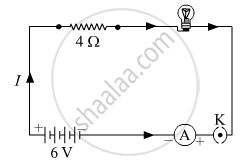
(a) the total resistance of the circuit,
(b) the current through the circuit,
(c) the potential difference across the (i) electric lamp and (ii) conductor, and
(d) power of the lamp.
Water : pipe :: Electric current : ______.
State whether true or false. If false, correct the statement.
Current can produce magnetic field.
MCB is used to protect household electrical appliances.
