Advertisements
Advertisements
प्रश्न
What happens to the resistance if the conductor is made thinner?
एका वाक्यात उत्तर
Advertisements
उत्तर
If the conductor is made thinner, electrons get smaller area of cross-section to flow and it therefore, offers a large resistance.
shaalaa.com
या प्रश्नात किंवा उत्तरात काही त्रुटी आहे का?
APPEARS IN
संबंधित प्रश्न
What happens to the other bulbs in a parallel circuit if one bulb blows off?
A wire of uniform thickness with a resistance of 27Ω is cut into three equal pieces and they are joined in parallel. Find the equivalent resistance of the parallel combination.
Distinguish between an open and a closed circuit.
Where is the main fuse in a house circuit connected?
The diagram shows two ways of connecting three lamps P, Q and R to A.C. supply of 220 V.
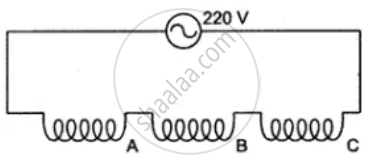
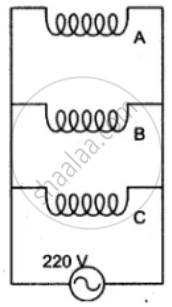
Name the two arrangements. Which of them would you prefer in a household circuit? Give a reason for your answer.
What would be the danger involved in replacing a blown fuse with the one which would carry a large current?
An electric bulb is rated 250 W, 230 V.
- the energy consumed in one hour, and
- the time in which the bulb will consume 1.0 kWh energy when connected to 230 V mains.
State the conditions for the flow of charge in a circuit from one point to the other.
A continuous and closed path of an electric current is called:
The direction of Direct Current (DC) is characterized as:
