Advertisements
Advertisements
प्रश्न
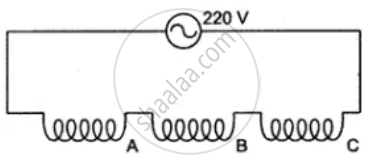
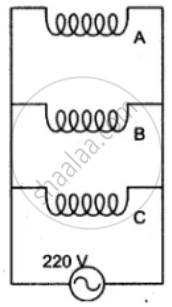
The diagram shows two ways of connecting three lamps P, Q and R to A.C. supply of 220 V.
Advertisements
उत्तर
The arrangement is shown in the figure (i) is a series arrangement. The arrangement in figure (ii) is the parallel arrangement.
We prefer a parallel arrangement. The reasons are:
(i) In series arrangement, if one of the bulbs is fused, the other bulbs also cease to glow. But in a parallel arrangement, if one bulb fuses, the other bulbs continue to glow.
(ii) In the series arrangement, while one bulb glows if the other bulb is switched on, the resistance of the circuit increases, and hence the bulbs glow less bright. But in a parallel arrangement, each bulb glows at the same voltage, therefore the glow of a bulb is unaffected if another bulb is switched on.
APPEARS IN
संबंधित प्रश्न
If 20 C of charge pass a point in a circuit in 1 s, what current is flowing?
What is an electric current?
A flash of lighting carries 10 C of charge which flows for 0.01 s. What is the current? If the voltage is 10 MV, what is the energy?
Consider the circuit given below:
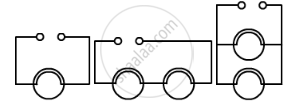
(a) In which circuit are the lamps dimmest?
(b) In which circuit or circuits are the lamps of equal brightness to the lamps in circuit (i)?
(c) Which circuit gives out the maximum light?
Tell the odd one out. Give a proper explanation.
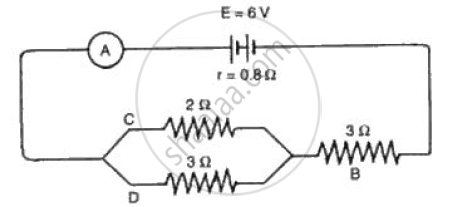
The circuit diagram (Fig.) shows a battery of e.m.f. 6 volts and internal
resistance of 0.8 Ω oonnected in series. Find the
(a) Current reoorded by the ammeter,
(b) P.d. across the terminals of the resistor B,
( c) Current passing through each of the resistors B, C and D, and
( d) P.d. across the terminals of the battery.
60 joules of heat was dissipated in a resistor when 20 C flowed for 5 s. Calculate:
(a) P.d. across the resistor,
(b) Resistance of the resistor, and
(c) Average power dissipated in the resistor.
A continuous and closed path of an electric current is called:
