Advertisements
Advertisements
प्रश्न
Advertisements
उत्तर
The charge on one electron is 1. 6 x 10-19 coulombs.
Therefore, lC charge carries `(1/(1.6 xx 10^19))` = 6.25 x 10¹⁸ electrons.
APPEARS IN
संबंधित प्रश्न
What is the Flow of Charge Called?
In which direction does conventional current flow around a circuit?
An electric circuit consisting of a 0.5 m long nichrome wire XY, an ammeter, a voltmeter, four cells of 1.5 V each and a plug key was set up.
Following graph was plotted between V and I values:
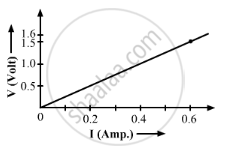
What would be the values of `V/I` rations when the potential difference is 0.8 V, 1.2 V and 1.6 V respectively?
What conclusion do you draw from these values?
What is the resistance of the wire?
In the network shown in the following adjacent Figure, calculate the equivalent resistance between the points.
- A and B
- A and C

Define the following:
Semiconductors
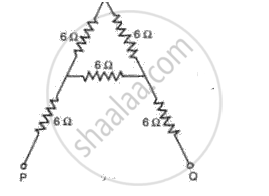
Find the effective resistance in the following circuit diagrams (Fig.):
Electrical appliances have voltage and power ratings as listed below. Which
has the larger working resistance?
| Appliances | Voltage (V) | Power (W) |
| (a) Washing machine | 250 | 3000 |
| ( b) Television | 240 | 160 |
| (c)240 | 240 | 1500 |
| ( d) Hair curler | 250 | 20 |
| ( e) Car head lamp | 12 | 36 |
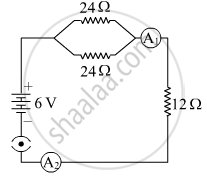
Study the following circuit and find out:
(i) Current in 12 Ω resistor.
(ii) The difference in the readings of A1 and A2, if any.
Problems for practice:
If 5A current flows through a circuit, then convert the current in terms of microampere?
