Advertisements
Advertisements
प्रश्न
A battery of e.m.f. 15 V and internal resistance 3 ohm is connected to two resistors of resistance 3 ohm and 6 ohm in series. Find:
(i) The current through the battery,
(ii) The p.d. between the terminals of the battery.
Advertisements
उत्तर
Given, emf, e = 15 v
Internal resistance, r = 3 `Omega`
Resistance of given two resistors in series, R, = 3 + 6 = 9 `Omega`
(i) Current = `"emf"/"Total resistance of circuit" = 15/(9 + 3) = 15/12` = 1.25 A
(ii) Potential difference= emf - voltage drop= e - (Ir)
Now, voltage drop= current x internal resistance= 1.25 x 3 = 3.75
.·. p.d. = 15 - 3.75= 11.25V
APPEARS IN
संबंधित प्रश्न
A p.d. of 6 V is applied to two resistors of 3 Ω and 6 Ω connected in parallel. Calculate:
(a) the combined resistance
(b) the current flowing in the main circuit
(c) the current flowing in the 3 Ω resistor.
Draw a circuit diagram showing two lamps, one cell and a switch connected in series.
How can you change the brightness of the lamp?
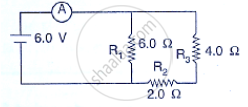
Three resistors of 6.0 𝛀, 2.0𝛀 and 4.0𝛀 are joined to an ammeter A and a cell of e.m.f. 6.0 V as
shown in fig 8.52 Calculate:
(a) the effective resistance of the circuit and
(b) the reading of ammeter.
An electric kettle has a heating element which is rated at 2 kW when connected to a 250 V electric supply. Calculate the
(a) Current which flows in the element when it is connected to a 250 V supply,
(b) Resistance of the filament,
(c) Heat produced in 1 minute by the element,
(d) Cost of running the kettle for 10 minutes a day for 30 days of the month, at the rate of Rs. 3.00 per unit.
If the potential differences between two parts of a thundercloud is 10s V,
what is the amount of energy given up during the passage of 20 coulombs?
(a)2x10⁻⁷J
(b)200J
(c)Sx106 j
(d)2x 10⁹J
(e)2x 10¹⁰ J
A bulb is connected to a battery of p.d. 4 V and internal resistance 2.5 Ω . A steady current of 0.5 A flows through the circuit. Calculate:
The energy dissipated in the bulb in 10 minutes.
State whether true or false. If false, correct the statement.
Current can produce magnetic field.
The power of an electric device is a product of ______ and ______.
The SI unit for electric current is the coulomb.
