Advertisements
Advertisements
प्रश्न
In the circuit diagram given below five resistances of 10 Ω, 40 Ω, 30 Ω, 20 Ω, and 60 Ω are connected as shown to a 12 V battery.
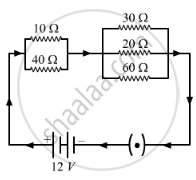
Calculate:
(a) total resistance in the circuit.
(b) total current flowing in the circuit.
Advertisements
उत्तर
(a) When three resistors are connected in parallel, the net resistance can be obtained as followed:
1/R = 1/R1 + 1/R2 + 1/R3
The resistors of 30 Ω, 20 Ω and 60 Ω are connected in parallel. Therefore, the net resistance R will be:
1/R = 1/30 + 1/20 +1/60
1/R = (2 + 3 + 1)/60
1/R = 6/60
R =10 Ω
Two more resistors of 10 Ω and 40 Ω are connected in parallel to each other. Therefore, their net resistance, R' will be:
1/R' = (1/10) + (1/40)
1/R' = (4 + 1)/40
1/R' = 5/40
R' = 8 Ω
The resistors of 8 Ω and 10 Ω are connected in series. Therefore, the net resistance of the circuit =R+R,=8 Ω + 10 Ω = 18 Ω
(b) The total current flowing through the circuit can be calculated as:
I = V/R
I = 12/18
I = 0.67 A
APPEARS IN
संबंधित प्रश्न
The SI unit of charge is volt.
If 20 C of charge pass a point in a circuit in 1 s, what current is flowing?
An electric circuit consisting of a 0.5 m long nichrome wire XY, an ammeter, a voltmeter, four cells of 1.5 V each and a plug key was set up.
(i) Draw a diagram of this electric circuit to study the relation between the potential difference maintained between the points 'X' and 'Y' and the electric current flowing through XY.
The p.d. across a 3 Ω resistor is 6 V. The current flowing in the resistor will be:
(a) `1/2A`
(b) 1 A
(c) 2 A
(d) 6 A
An electric bulb of resistance 20 Ω and a resistance wire of 4 Ω are connected in series with a 6 V battery.
Draw the circuit diagram, and calculate:
(a) total resistance of the circuit.
(b) current through the circuit.
(c) potential difference across the electric bulb.
(d) potential difference across the resistance wire.
A p.d. of 6 V is applied to two resistors of 3 Ω and 6 Ω connected in parallel. Calculate:
(a) the combined resistance
(b) the current flowing in the main circuit
(c) the current flowing in the 3 Ω resistor.
A 720 W heater operates from a 220 V line voltage. Calculate:
(a) The electrical energy consumed by the heater in 3 h.
(b) The cost of electrical energy consumption at the rate of 60 paise per kWh.
Calculate the amount of energy transferred by a 10 A electric current flowing through a resistor of 5 o for 15 minutes.
Electrical power P is given by the expression P = (Q × V) ÷ time
(a) What do the symbols Q and V represent?
(b) Express the power P in terms of current and resistance explaining the meanings of symbols used there in.
State the S.I. units of electrical power.
A bulb is connected to a battery of p.d. 4 V and internal resistance 2.5 Ω . A steady current of 0.5 A flows through the circuit. Calculate:
The total energy supplied by the battery in 10 minutes
What is meant by internal resistance of a cell?
State the conditions for the flow of charge in a circuit from one point to the other.
Small amounts of electrical current are measured in milliampere (mA). How many milliampere are there in 0.25 A ?
What is the speed of electric current?
What is the rate at which charges flow past a point on a circuit?
