Advertisements
Advertisements
प्रश्न
Answer the following question.
An electric lamp of resistance 20 Ω and a conductor of resistance 4 0 are connected to a 6 V battery as shown in the circuit. Calculate: 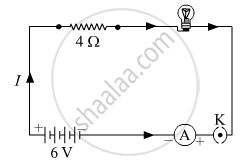
(a) the total resistance of the circuit,
(b) the current through the circuit,
(c) the potential difference across the (i) electric lamp and (ii) conductor, and
(d) power of the lamp.
Advertisements
उत्तर
Resistance of electric lamp = 20 Ω
Resistance of conductor = 4 Ω
Voltage battery = 6 V
(a) Total resistance of circuit = 20 Ω + 4 Ω = 24
(b) Resistance of conductor= 4 Ω
Voltage battery = 6 V
Apply Ohms law
6 V =` "I"` × 24 Ω
`"I" = (6"V")/(24Ω) = 0.25"A"`
Hence, current in the circuit is 0.25A
(c)
(i) Potential difference across the lamp
Vlamp = IR
Vlamp = 0.25 A × 20 Ω = 5 V
∴ Vlamp = 5 V
(ii) Potential difference across the conductor
`"V"_"conductor" = "IR"`
`"V"_"conductor" = 0.25 "A"xx4 Ω = 1 "V"`
`"V"_"conductor" = 1"V"`
(d) Power of lamp
`"I"^(2)"R" = (0.25)^2 xx 20 = 1.25 "W"`
APPEARS IN
संबंधित प्रश्न
<p> Define the unit of electric current (or Define ampere).
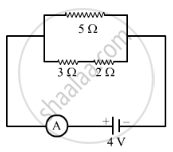
(a) With the help of a circuit diagram, obtain the relation for the equivalent resistance of two resistances connected in parallel.
(b) In the circuit diagram shown below, find:
(i) Total resistance.
(ii) Current shown by the ammeter A
A wire of length 5 m has a resistance of 2.0 Ω calculate:
(a) the resistance of wire of length 1 m
(b) the equivalent resistance if two such wires each of length 2 m are joined in parallel.
(c) the resistance of 1 m length of wire of same material but of half diameter.
A bulb marked 12 V, 24 W operates on a 12 volt car battery for 20 minutes. Calculate:
(i) The current flowing through it, and
(ii) The energy liberated.
A battery of e.m.f. 15 V and internal resistance 2 Ω is connected to two resistors of resistances 4 ohm and 6 ohm joined (a) in series. Find in each case the electrical energy spent per minute in 6 Ω resistor.
State the condition when it is advantageous to connect cells in series.
Three resistances, of which two are equal when connected in series have an effective resistance of 30 ohms. When the three resistances are connected in parallel, the effective resistances is 3 ohms. Find the values of the individual resistances.
MCB is used to protect household electrical appliances.
In electrolytes such as salt solutions, the charge carriers are:
