Advertisements
Advertisements
प्रश्न
State two differences between the e.m.f. and terminal voltage of a cell.
State the differences between terminal voltage and emf.
Advertisements
उत्तर
| Sr. No. | e.m.f. of cell | Terminal voltage of cell |
| 1. | The amount of work required to move a unit positive charge in the entire circuit, both inside and outside the cell, serves as the measurement. | The amount of work required to move a unit of positive charge outside the cell serves as the measurement. |
| 2. | It is the characteristic of the cell, i.e., it does not depend on the amount of current drawn from the cell | It depends on the amount of current drawn from the cell. The more current drawn from the cell, the lower the terminal voltage. |
| 3. | It is equal to the terminal voltage when the cell is not in use and greater than the terminal voltage when the cell is in use. | It is equal to the cell's EMf when it is not in use, while it is less than the EMf when it is in use. |
संबंधित प्रश्न
Three 2 V cells are connected in series and used as a battery in a circuit.
How many joules of electrical energy does 1 C gain on passing through (i) one cell (ii) all three cells?
Draw a circuit diagram to show how two 4 V electric lamps can be lit brightly from two 2 V cells.
If you were going to connect two light bulbs to one battery, would you use a series or a parallel arrangement? Why? Which arrangement takes more current from the battery?
State the S.I. unit of current.
A wire of uniform thickness with a resistance of 27Ω is cut into three equal pieces and they are joined in parallel. Find the equivalent resistance of the parallel combination.
A wire is passed through a piece of cardboard as shown in fig .. An electric current flows vertically down the wire and then flows back up. The two sections of the write are observed to repel each other.
(a) Wi th the aid of a diagram, describe how you would plot the magnetic field lines on the card .
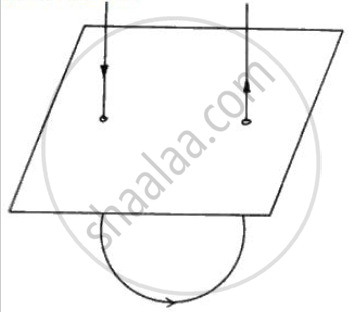
(b) Sketch the magnetic field patterns around both the sections of the wire. Use your sketch to explain why the two sections repel each other.
(c) The repulsive force between the two sections is small. What changes could be made to increase it?
For current to flow, one needs art open circuit.
The SI unit of electric current is:
