Advertisements
Advertisements
प्रश्न
A battery of e.m.f. 15 V and internal resistance 3 ohm is connected to two resistors of resistance 3 ohm and 6 ohm in series. Find:
(i) The current through the battery,
(ii) The p.d. between the terminals of the battery.
Advertisements
उत्तर
Given, emf, e = 15 v
Internal resistance, r = 3 `Omega`
Resistance of given two resistors in series, R, = 3 + 6 = 9 `Omega`
(i) Current = `"emf"/"Total resistance of circuit" = 15/(9 + 3) = 15/12` = 1.25 A
(ii) Potential difference= emf - voltage drop= e - (Ir)
Now, voltage drop= current x internal resistance= 1.25 x 3 = 3.75
.·. p.d. = 15 - 3.75= 11.25V
APPEARS IN
संबंधित प्रश्न
In which direction does conventional current flow around a circuit?
<p> Define the unit of electric current (or Define ampere).
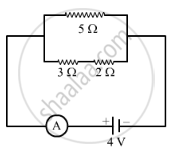
(a) With the help of a circuit diagram, obtain the relation for the equivalent resistance of two resistances connected in parallel.
(b) In the circuit diagram shown below, find:
(i) Total resistance.
(ii) Current shown by the ammeter A
Match the pairs.
| ‘A’ Group | ‘B’ Group |
| 1. Free electrons | a. V/R |
| 2. Current | b. Increases the resistance in the circuit |
| 3. Resistivity | c. Weakly attached |
| 4. Resistances in series | d. VA/LI |
Explain with the help of a diagram how does 'short circuiting' occur in an electric kettle.
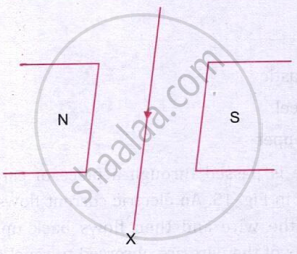
In fig. XY is at right angles to the magnetic field. The direction in which XY should be moved to induce an electron flow in the direction Y to X as indicated by the arrow is:
Three heaters each rated 250 W, 100 V are connected in parallel to a 100 V supply of the energy supplied in kWh to the three heaters in 5 hours.
Coulomb is the SI unit of ____________.
Problems for practice:
If 3A current flows through a circuit, then convert the current in terms of a milliampere.
Define the following:
Conventional current
