Advertisements
Advertisements
प्रश्न
An electric bulb is marked 100 W, 250 V. How much current will the bulb draw if connected to a 250 V supply?
Advertisements
उत्तर
Given 250 V, I = ?
∵ P = VI
⇒ 100 = 250 × I
∴ I = `100/250 = 0.4` Amp.
संबंधित प्रश्न
Three resistors are connected as shown in the diagram.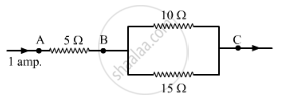
Through the resistor 5 ohm, a current of 1 ampere is flowing.
(i) What is the current through the other two resistors?
(ii) What is the p.d. across AB and across AC?
(iii) What is the total resistance
What would be the danger involved in replacing a blown fuse with the one which would carry a large current?
State whether the current is a scalar or vector?
Fill in the blank :
1 mA = ............................. A.
Answer the following question.
An electric lamp of resistance 20 Ω and a conductor of resistance 4 0 are connected to a 6 V battery as shown in the circuit. Calculate: 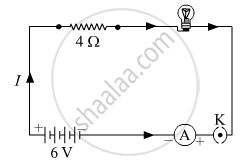
(a) the total resistance of the circuit,
(b) the current through the circuit,
(c) the potential difference across the (i) electric lamp and (ii) conductor, and
(d) power of the lamp.
Small amounts of electrical current are measured in milliampere (mA). How many milliampere are there in 0.25 A ?
Unit of electric power may also be expressed as
A current of 2A passing through the conductor produces 80 J of heat in 10 seconds. The resistance of the conductor is ______.
