Advertisements
Advertisements
प्रश्न
Advertisements
उत्तर
The charge on one electron is 1. 6 x 10-19 coulombs.
Therefore, lC charge carries `(1/(1.6 xx 10^19))` = 6.25 x 10¹⁸ electrons.
APPEARS IN
संबंधित प्रश्न
What is the conventional direction of the flow of electric current? How does it differ from the direction of flow electrons?
The following table shows the current in Amperes and potential differences in Volts.
- Find the average resistance.
- What will be the nature of the graph between the current and potential difference? (Do not draw a graph.)
- Which law will the graph prove? Explain the law.
| V (volts) | I (amp) |
| 4 | 9 |
| 5 | 11.25 |
| 6 | 13.5 |
A 720 W heater operates from a 220 V line voltage. Calculate:
(a) The electrical energy consumed by the heater in 3 h.
(b) The cost of electrical energy consumption at the rate of 60 paise per kWh.
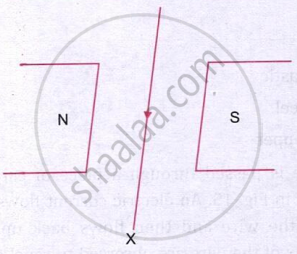
In fig. XY is at right angles to the magnetic field. The direction in which XY should be moved to induce an electron flow in the direction Y to X as indicated by the arrow is:
Three heaters each rated 250 W, 100 V are connected in parallel to a 100 V supply. Calculate :
The total current taken from the supply
Which part of an electrical appliance is earthed?
Conventionally, the direction of the current is taken as:
Match the following:
| 1. | 1 mA | a. | series |
| 2. | 1 pA | b. | ohmmeter |
| 3. | Ammeter | c. | 10-6 ampere |
| 4. | Electrical resistivity | d. | 10-3 ampere |
The magnitude of Alternating Current (AC):
