Advertisements
Advertisements
प्रश्न
A uniform wire with a resistance of 27 Ω is divided into three equal pieces and then they are joined in parallel. Find the equivalent resistance of the parallel combination.
Advertisements
उत्तर
When a wire of uniform thickness with a resistance 27 Ω is cut into three equal pieces, the resistance of each piece = `27 /3` = 9 Ω.
Now, the equivalent resistance of three 9 Ω resistors connected in parallel is:
RP = `[1/9 + 1/9 + 1/9]^-1`
= 3 Ω
संबंधित प्रश्न
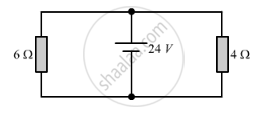
Find the current in each resistor in the circuit shown below:
A resistor has a resistance of 176 ohms. How many of these resistors should be connected in parallel so that their combination draws a current of 5 amperes from a 220 volt supply line?
The figure given below shows three resistors?
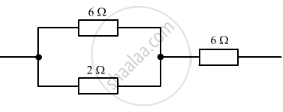
Their combined resistance is:
(a) `1 5/7`Ω
(b) `14` Ω
(c) `6 2/3` Ω
(d) `7 1/2` Ω
If current flows through two lamps arranged:
(a) in series,
(b) in parallel,
and the filament of one lamps breaks, what happens to the other lamp? Explain your answer.
Which of the following combinations have the same equivalent resistance between X and Y?
You have three resistors of values 2Ω, 3Ω and 5Ω. How will you join them so that the total resistance is less than 1Ω? Draw diagram and find the total resistance.
State the S.I. unit of electrical resistance and define it.
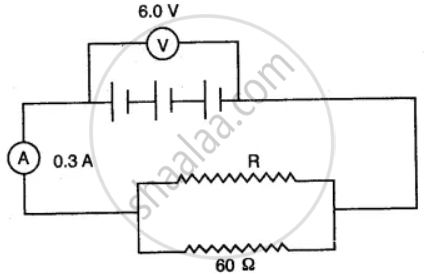
In the figure below, the ammeter A reads 0.3 A. Calculate:
(i) the total resistance of the circuit
(ii) the value of R
(iii) the current flowing through R.
A piece of wire having a resistance R is cut into five equal parts.
- How will the resistance of each part of the wire change compared with the original resistance?
- If the five parts of the wire are placed in parallel, how will the resistance of the combination change?
- What will be ratio of the effective resistance in series connection to that of the parallel connection?
Four resistors each of resistance 5 Ω are connected in parallel. What is the effective resistance?
