Advertisements
Advertisements
Question
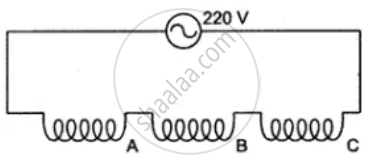
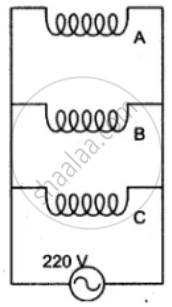
The diagram shows two ways of connecting three lamps P, Q and R to A.C. supply of 220 V.
Advertisements
Solution
The arrangement is shown in the figure (i) is a series arrangement. The arrangement in figure (ii) is the parallel arrangement.
We prefer a parallel arrangement. The reasons are:
(i) In series arrangement, if one of the bulbs is fused, the other bulbs also cease to glow. But in a parallel arrangement, if one bulb fuses, the other bulbs continue to glow.
(ii) In the series arrangement, while one bulb glows if the other bulb is switched on, the resistance of the circuit increases, and hence the bulbs glow less bright. But in a parallel arrangement, each bulb glows at the same voltage, therefore the glow of a bulb is unaffected if another bulb is switched on.
APPEARS IN
RELATED QUESTIONS
Which particles constitute the electric current in a metallic conductor?
Which type of circuit, series or parallel, is preferred while connecting a large number of bulbs:
(a) for decorating a hotel building from outside?
An electrician has wired a house in such a way that if a lamp gets fused in one room of the house, all the lamps in other rooms of the house stop working. What is the defect in the wiring?
In which of the following cases more electrical energy is consumed per hour?
(i) A current of 1 ampere passed through a resistance of 300 ohms.
(ii) A current of 2 amperes passed through a resistance of 100 ohms.
The work done in moving unit positive charge across two points in an electric circuit is a measure of
Calculate the amount of energy transferred by a 10 A electric current flowing through a resistor of 5 o for 15 minutes.
An electric kettle has a heating element which is rated at 2 kW when connected to a 250 V electric supply. Calculate the
(a) Current which flows in the element when it is connected to a 250 V supply,
(b) Resistance of the filament,
(c) Heat produced in 1 minute by the element,
(d) Cost of running the kettle for 10 minutes a day for 30 days of the month, at the rate of Rs. 3.00 per unit.
An electric bulb is rated '100 W, 250 V'. How much current will the bulb draw if connected to a 250 V supply?
- What is meant by electric current?
- Name and define its unit.
- Which instrument is used to measure the electric current? How should it be connected in a circuit?
Common sources of Direct Current (DC) are:
