Advertisements
Advertisements
Question
Complete the following table. The first answer has been given as an example
| Quantity | Unit |
|
(a) Electrical potential Volt ( b) Resistance ( c) Power ( d) Energy ( e) Resistivity |
Volt ........ .......... ............ .............. |
Advertisements
Solution
| Quantity | Unit |
| 1. Electrical potential | volt |
| 2. Resistance | ohm |
| 3. Power | watt |
| 4. Enerqy | Joule |
| 5. Resistivity | Ohm-meter |
APPEARS IN
RELATED QUESTIONS
Why are metals good conductors of electricity whereas glass is a bad conductor of electricity? Give reason?
Which of the following equation shows the correct relationship between electrical unit?
1A = 1C/s or 1c= 1A/s
In the circuit diagram given below five resistances of 10 Ω, 40 Ω, 30 Ω, 20 Ω, and 60 Ω are connected as shown to a 12 V battery.
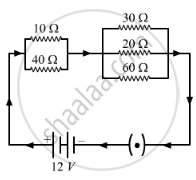
Calculate:
(a) total resistance in the circuit.
(b) total current flowing in the circuit.
State the S.I. unit of current.
Answer the following question.
An electric lamp of resistance 20 Ω and a conductor of resistance 4 0 are connected to a 6 V battery as shown in the circuit. Calculate: 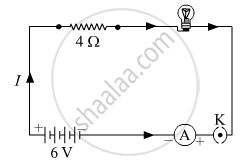
(a) the total resistance of the circuit,
(b) the current through the circuit,
(c) the potential difference across the (i) electric lamp and (ii) conductor, and
(d) power of the lamp.
Assertion (A): Electric current will not flow between two charged bodies when connected if their charges are the same.
Reason (R): Current is the rate of flow of charge.
Define the following:
Conventional current
