Advertisements
Advertisements
प्रश्न
The atoms of copper contain electrons and the atoms of rubber also contain electrons. Then why does copper conduct electricity but rubber does not conduct electricity?
Advertisements
उत्तर
In a copper atom, the electrons in the outermost orbit are lightly bound to the nucleus of the atom and so they move freely. This free flow of electrons makes copper a good conductor of electricity. In rubber, the electrons in the outermost orbits are tightly bound to the nucleus. So, they do not flow freely and hence, rubber is not a good conductor of electricity.
APPEARS IN
संबंधित प्रश्न
In which direction do electrons flow?
How many microamperes are there in 1 ampere?
A 5 V battery is connected to two 20 Ω resistors which are joined together in series.
(a) Draw a circuit diagram to represent this. Add an arrow to indicate the direction of conventional current flow in the circuit.
(b) What is the effective resistance of the two resistors?
(c) Calculate the current that flows from the battery?
(d) What is the p.d. across each resistor?
A battery and three lamps are connected as shown:
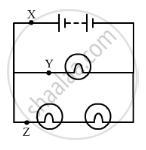
Which of the following statements about the currents at X, Y and Z is correct?
(a) The current at Z is greater than that at Y.
(b) The current at Y is greater than that at Z.
(c) The current at X equals the current at Y.
(d) The current at X equals the current at Z.
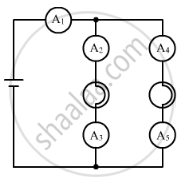
If the lamps are both the same in the figure given below and if A1 reads 0.50 A, what do A2, A3, A4 and A5 read?
Define the following:
Electromotive force
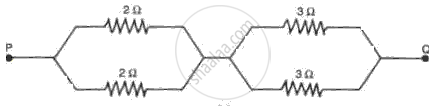
Find the effective resistance in the following circuit diagrams (Fig.):
What is the criteria for selecting a fuse wire?
What would be the danger involved in replacing a blown fuse with the one which would carry a large current?
The circuit diagram in fig shows two coils of an insulated copper wire wound on a cardboard tube. G is a center zero galvanometer.
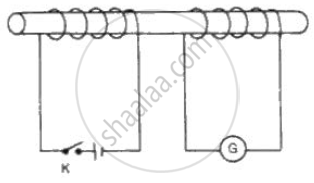
(a) Describe what will happen when th e swi tch K is cl osed for severa l
seconds and then opened again .
(b) What will be the effect of repeating the experiment with an iron placed in the tube?
1 kWh = `(1 "volt" xx 1 "ampere" xx "_________")/1000`
A bulb of 40 W is used for 12.5 h each day for 30 days. Calculate the electrical energy consumed.
State whether the following statement is True or False:
The SI unit of charge is the coulomb.
One unit of electrical energy consumed is equal to 1000 kilowatt-hour.
A continuous and closed path of an electric current is called:
Electric current flows through a circuit only when:
