Advertisements
Advertisements
प्रश्न
A current of 0.2 A flows through a wire whose ends are at a potential difference of 15 V. Calculate:
(i) The resistance of the wire, and
(ii) The heat energy produced in 1 minute.
Advertisements
उत्तर
Given ,
Current, I = 0.2 A
Potential difference , V = 15 V
Time ,t = 60 sec
As V = IR
(a) R = `15/0.2 = 75 Omega`
(b) Heat energy , H = I2Rt
H = (0.2)2 × 75 × 60
or H = 180 J
संबंधित प्रश्न
Calculate the number of electrons constituting one coulomb of charge.
Which of the following equation shows the correct relationship between electrical unit?
1A = 1C/s or 1c= 1A/s
A battery of 9 V is connected in series with resistors of 0.2 Ω, 0.3 Ω, 0.4 Ω, 0.5 Ω and 12 Ω. How much current would flow through the 12 Ω resistor?
In the circuit shown below, the voltmeter reads 10 V.
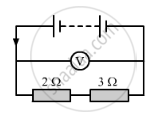
(a) What is the combined resistance?
(b) What current flows?
(c) What is the p.d. across 2 Ω resistor?
(d) What is the p.d. across 3 Ω resistor?
How do you think the brightness of two lamps arranged in parallel compares with the brightness of two lamps arranged in series (both arrangements having one cell)?
The work done in moving unit positive charge across two points in an electric circuit is a measure of
A fuse is a short piece of wire of high ______ and low ______.
MCB is used to protect household electrical appliances.
The SI unit of electric current is:
