Advertisements
Advertisements
प्रश्न
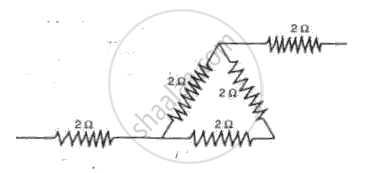
Find the effective resistance in the following circuit diagrams (Fig.):
Advertisements
उत्तर
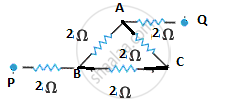
In the path ACB, the series combination of two 2Ω resistor is connected in parallel with the third 2Ω resistor.
:. resislancein series= 2 + 2 = 4 Ω
This 4 Ω resistor is now connected in parallel with the 2Ω resistor
total resistance between A and B `(1/"R"_"P") = 1/4 + 1/2 = 3/4 Ω`
`"R"_"P" = 4/3 Omega`
Now, between P and Q, two 2Ω resistors and `4/3` Ω are connected in series.
total resistance of the given network, R, = `2 + 2 + 4/3 = (6 + 6 + 4)/3 = 16/3 = 5.3Ω`
APPEARS IN
संबंधित प्रश्न
Why should the resistance of:
an ammeter be very small?
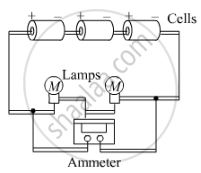
A student made an electric circuit shown here to measure the current through two lamps.
Are the lamps in series or parallel?
(a) Are the lamps in series or parallel?
(b) The student has made a mistake in this circuit. What is the mistake?
(c) Draw a circuit diagram to show the correct way to connect the circuit. Use the proper circuit symbols in your diagram.
A p.d. of 6 V is applied to two resistors of 3 Ω and 6 Ω connected in parallel. Calculate:
(a) the combined resistance
(b) the current flowing in the main circuit
(c) the current flowing in the 3 Ω resistor.
V1, V2 and V3 are the p.ds. across the 1Ω, 2Ω and 3Ω resistors in the following diagram, and the current is 5 A.
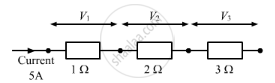
Which one of the columns (a) to (d) shows the correct values of V1, V2 and V3measured in volts?
`V_1` `V_2` `V_3`
(a) 1.0 2.0 3.0
(b) 5.0 10.0 15.0
(c) 5.0 2.5 1.6
(d) 4.0 4.0 2.0
Which effect of current is utilised in an electric light bulb?
Tick(✓) the correct choice in the following:
The outer casing of an electric iron is generally connected to earth in order
to
Define the following:
Super conductors
A bulb is connected to a battery of p.d. 4 V and internal resistance 2.5 Ω . A steady current of 0.5 A flows through the circuit. Calculate:
The total energy supplied by the battery in 10 minutes
Which part of an electrical appliance is earthed?
