Advertisements
Advertisements
प्रश्न
How many electrons are flowing per second past a point in a circuit in which there is a current of 5 amp?
Advertisements
उत्तर
Current, I = 5 A
Time, t = 1 s
Using the relation, I = Q / t:
Q = I x t
= 5 x 1 = 5 C
Now, if the charge is `1.6xx10^-19C` the number of electrons is one.
So, if the charge is 5C, the number of electrons is given by:
`1/(1.6xx10^-19)xx5=31.25xx10^18`
APPEARS IN
संबंधित प्रश्न
Draw the electrical symbols of the following components and state its use
Wire crossing
If the charge on an electron is 1.6 × 10⁻¹⁹ coulombs, how many electrons should pass through a conductor in 1 second to constitute 1 ampere current?
What is the conventional direction of the flow of electric current? How does it differ from the direction of flow electrons?
A car headlight bulb working on a 12 V car battery draws a current of 0.5 A. The resistance of the light bulb is:
If you were going to connect two light bulbs to one battery, would you use a series or a parallel arrangement? Why? Which arrangement takes more current from the battery?
Find the effective resistance in the following circuit diagrams (Fig.):
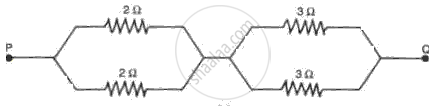
Find the effective resistance in the following circuit diagrams (Fig.):
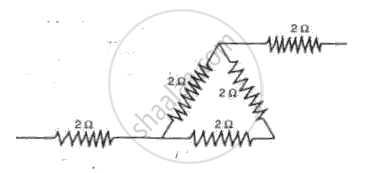
A 3 pin mains plug is fitted to the lead for a 1 kW electric kettle to be used on a 250 V A.C. supply. Which of the following statements is NOT correct?
(a) A 13 A fuse is the most appropriate value to use.
(b) The brown wire should be connected to the live side of the mains.
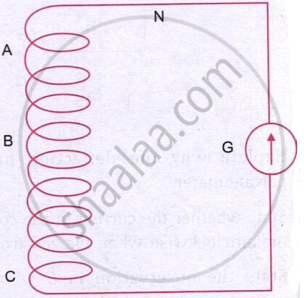
A strong short bar magnet is dropped into a solenoid connected to a
galvanometer as shown in fig. The galvanometer shows a deflection to the left when the current in the coil as seen from above is counter clockwise. Which one of the following shows the correct deflection of the galvanometer when the magnet is at posi tions A, Band C.
State the S.I. units of electrical power.
An electric bulb is rated at 220 V, 100 W.
- What is its resistance?
- What safe current can be passed through it?
Three heaters each rated 250 W, 100 V are connected in parallel to a 100 V supply of the energy supplied in kWh to the three heaters in 5 hours.
Explain, why the potential difference across the terminals of a cell is more when the cell is not in use than it is when the cell is being used.
The SI unit for electric current is the coulomb.
- What is meant by electric current?
- Name and define its unit.
- Which instrument is used to measure the electric current? How should it be connected in a circuit?
When an electric current is passed, electrons move from:
What is the rate at which charges flow past a point on a circuit?
In ionised gases (plasma), the charge carriers are:
The direction of Direct Current (DC) is characterized as:
