Advertisements
Advertisements
Question
Three resistances, of which two are equal when connected in series have an effective resistance of 30 ohms. When the three resistances are connected in parallel, the effective resistances is 3 ohms. Find the values of the individual resistances.
Advertisements
Solution
When connected in series, R = R1 + R1 + R2 (two are equal)
R = 2R1 + R2
∴ 2R1 + R2 = 30 ....(R = 30 Ω)
∴ 2R1 = 30 - R2
∴ R1 = `(30 - "R")/2` .....(i)
When connected in parallel,
`1/"R" = 1/"R"_1 + 1/"R"_1 + 1/"R"_2`
Or `1/"R" = 1/((30 - "R"_2)/2) + 1/((30 - "R"_2)/2) + 1/"R"_2` ....(From equation (i))
∴ `1/"R" = 2/(30 - "R"_2) + 2/(30 - "R"_2) + 1/"R"_2`
`1/3 = 4/(30 - "R"_2) + 1/"R"_2` ...(as R = 3Ω)
∴ `1/3 = (4"R"_2 + 30 - "R"_2)/("R"_2
(30 - "R"_2)) = (3"R"_2 + 30)/("R"_2(30 - "R"_2))`
∴ R2 `(30 - "R"_2)/3 = 9 "R"_2 + 90`
`30"R"_2 - "R"_2^2 = 9"R"_2 + 90`
`"R"_2^2 - 21 "R"_2 + 90 = 0`
∴ R2 - 6R2 - 15R2 + 90 = 0
∴ R2 = 6 or 15
∴ R1 = `(30 - 6)/2` or `(30 - 15)/2`
R1 = 12 Ω or 7.5 Ω
The three resistances can have values 12 Ω, 12 Ω and 6 Ω or 15 Ω, 7.5 Ω and 7.5 Ω.
RELATED QUESTIONS
Which statement/statement is/are correct?
1. An ammeter is connected in series in a circuit and a voltmeter is connected in parallel.
2. An ammeter has a high resistance.
3. A voltmeter has a low resistance.
(a) 1, 2, 3
(b) 1, 2
(c) 2, 3
(d) 1
In the circuit diagram given below five resistances of 10 Ω, 40 Ω, 30 Ω, 20 Ω, and 60 Ω are connected as shown to a 12 V battery.
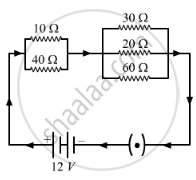
Calculate:
(a) total resistance in the circuit.
(b) total current flowing in the circuit.
Which effect of current is utilised in the working of an electric fuse?
A battery of e.m.f. 15 V and internal resistance 3 ohm is connected to two resistors of resistance 3 ohm and 6 ohm in series. Find:
(i) The current through the battery,
(ii) The p.d. between the terminals of the battery.
Calculate the amount of energy transferred by a 10 A electric current flowing through a resistor of 5 o for 15 minutes.
Tick (✓) the correct choice among the following :
Which of the following changes would enable a millimeter to be used as a
direct current ammeter reading upto 1 A?
- What is meant by electric current?
- Name and define its unit.
- Which instrument is used to measure the electric current? How should it be connected in a circuit?
In the process of current flow through a conductor, the amount of charge passing per unit time gives:
