English

A 200 V Electric Transfer Draws an Electric Current of 11 A. What is Its Electrical Resistance? - Physics

Advertisements
Advertisements

Question

A 200 v electric transfer draws an electric current of 11 A. What is its electrical resistance?
Numerical
Advertisements

Solution

AIC to Ohm's law;

V=IR

Here, V = 200 volt and I= 11 A

R = `"V"/"I" = 200/11 = 18.2 Omega`

shaalaa.com
  Is there an error in this question or solution?
Chapter 4: Current Electricity - Exercise 4.2 ii [Page 188]

APPEARS IN

Frank Physics - Part 2 [English] Class 10 ICSE
Chapter 4 Current Electricity
Exercise 4.2 ii | Q 2 | Page 188

RELATED QUESTIONS

Which statement/statement is/are correct?
1. An ammeter is connected in series in a circuit and a voltmeter is connected in parallel.
2. An ammeter has a high resistance.
3. A voltmeter has a low resistance.

(a) 1, 2, 3
(b) 1, 2
(c) 2, 3
(d) 1


A 5 V battery is connected to two 20 Ω resistors which are joined together in series.

(a) Draw a circuit diagram to represent this. Add an arrow to indicate the direction of conventional current flow in the circuit.
(b) What is the effective resistance of the two resistors?
(c) Calculate the current that flows from the battery?
(d) What is the p.d. across each resistor?


(a) With the help of a circuit diagram, obtain the relation for the equivalent resistance of two resistances connected in parallel.
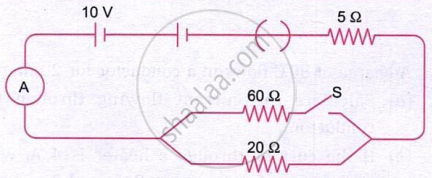
(b) In the circuit diagram shown below, find:

(i) Total resistance.
(ii) Current shown by the ammeter 


How do you think the brightness of two lamps arranged in parallel compares with the brightness of two lamps arranged in series (both arrangements having one cell)?


By what name is the unit joule/coulomb called?

Many electrical appliances and circuits are earthed grounded. What is the reason for this?

Complete the following table. The first answer has been given as an example

Quantity Unit

(a) Electrical potential Volt

( b) Resistance

( c) Power

( d) Energy

( e) Resistivity

Volt

........

..........

............

..............


Why is an ammeter always connected in series while the voltmeter always in parallel to a circuit across which voltage is to be measured?

Describe two experiments to illustrate the production of electric current by electromagnetic induction. State the laws which determine the direction and magnitude of the induced current.

Tick (✓) the correct choice among the following :
(a) A strong short bar magnet is dropped into a solenoid connected to a
galvanometer as shown in fig . The galvanometer shows a deflection to the left when the current in the coil as seen from above is counter clockwise. Which one of the following shows the correct deflection of the galvanometer when the magnet is at posi tions A, Band C.


Share
Notifications

Englishहिंदीमराठी


      Forgot password?
Use app×