Advertisements
Advertisements
Question
How does the heat H produced by a current passing through a fixed resistance wire depend on magnitude of current I?
Advertisements
Solution
Heat produced by a current passing through a wire with a fixed resistance depends on the square of current, I.
Heat, H = I2 x R x t
APPEARS IN
RELATED QUESTIONS
Which particles constitute the electric current in a metallic conductor?
What Makes an Electric Current Flow in a Wire?
If the current through a floodlamp is 5 A, what charge passed in 10 seconds?
(a) 0.5 C
(b) 2 C
(c) 5 C
(d) 50 C
State two differences between the e.m.f. and terminal voltage of a cell.
A wire of uniform thickness with a resistance of 27Ω is cut into three equal pieces and they are joined in parallel. Find the equivalent resistance of the parallel combination.
An electric current flowing in a wire creates ______ around the wire.
The diagram shows two ways of connecting three lamps P, Q and R to A.C. supply of 220 V.
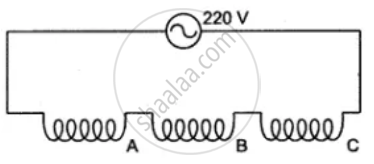
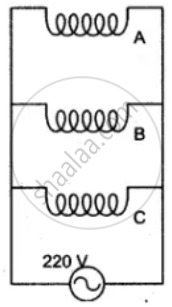
Tick(✓) the correct choice in the following:
24 watt, 12 volt head lamp is fully lit by connecting it to a 12 volt
battery. The working resistance of the lamp is
Define the following:
Electromotive force
In the circuit shown in fig., find the reading of the ammeter A when the switch S is opened.
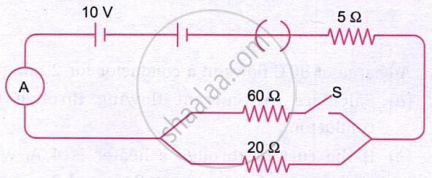
An electric kettle is rated 2.5 kW, 250 V. Find the cost of running the kettle for two hours at Rs. 5.40 per unit.
Small amounts of electrical current are measured in milliampere (mA). How many milliampere are there in 0.25 A ?
State whether true or false. If false, correct the statement.
Current can produce magnetic field.
Match the items in column-I to the items in column-II:
| Column - I | Column - II | ||
| (i) | electric current | (a) | volt |
| (ii) | potential difference | (b) | ohm meter |
| (iii) | specific resistance | (c) | watt |
| (iv) | electrical power | (d) | joule |
| (v) | electrical energy | (e) | ampere |
Which of the following correctly represents the formula for electric current?
The electron was discovered in 1897 by:
In ionised gases (plasma), the charge carriers are:
