Advertisements
Advertisements
प्रश्न
Consider the circuit given below:
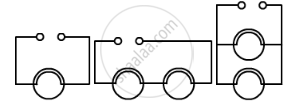
(a) In which circuit are the lamps dimmest?
(b) In which circuit or circuits are the lamps of equal brightness to the lamps in circuit (i)?
(c) Which circuit gives out the maximum light?
Advertisements
उत्तर
(a) The lamps will be the dimmest in the series circuit (ii) because the voltage will be divided between the two lamps.
(b) In circuit (iii), the lamps will be as bright as in circuit (i) because circuit (iii) is a parallel arrangement. In a parallel arrangement, the voltage remains the same.
(c) Circuit (iii) will give the maximum light as circuit (iii) has a parallel arrangement. A parallel arrangement offers less resistance and thus circuit (iii) will give more light.
APPEARS IN
संबंधित प्रश्न
Choose the correct alternative and rewrite the following sentence.
When the resistance of a conductor increases, the current will ________ increase.
Which of the two is connected in series : ammeter or voltmeter?
Tell the odd one out. Give a proper explanation.
If a charge of 420 C flows through a conducting wire in 5 minutes what is the value of the current?
Tick(✓) the correct choice in the following:
A three pin plug is connected to the lead for a 1 kW electric iron to be
used on a 250 V supply. Which of the following statements is not correct?
Two resistors P and Q of the same material and length but of different thickness are connected in parallel to a battery. The cross- sectional area of P is twice that of Q. What is the ratio of
(a) The resistance of P to the resistance of Q?
(b) The current in P to the current in Q?
What would be the danger involved in replacing a blown fuse with the one which would carry a large current?
Electrical appliances have voltage and power ratings as listed below. Which
has the larger working resistance?
| Appliances | Voltage (V) | Power (W) |
| (a) Washing machine | 250 | 3000 |
| ( b) Television | 240 | 160 |
| (c)240 | 240 | 1500 |
| ( d) Hair curler | 250 | 20 |
| ( e) Car head lamp | 12 | 36 |
If the potential differences between two parts of a thundercloud is 10s V,
what is the amount of energy given up during the passage of 20 coulombs?
(a)2x10⁻⁷J
(b)200J
(c)Sx106 j
(d)2x 10⁹J
(e)2x 10¹⁰ J
A current of 0.2 A flows through a wire whose ends are at a potential difference of 15 V. Calculate:
(i) The resistance of the wire, and
(ii) The heat energy produced in 1 minute.
Three resistances, of which two are equal when connected in series have an effective resistance of 30 ohms. When the three resistances are connected in parallel, the effective resistances is 3 ohms. Find the values of the individual resistances.
Water : pipe :: Electric current : ______.
Unit of electric power may also be expressed as
Problems for practice:
If 3A current flows through a circuit, then convert the current in terms of a milliampere.
Calculate the current in a wire if a charge of 1500 coulomb flows through it in 5 minutes.
Electric current is defined as:
