Advertisements
Advertisements
Question
Advertisements
Solution
APPEARS IN
RELATED QUESTIONS
The SI unit of charge is volt.
What is the conventional direction of the flow of electric current? How does it differ from the direction of flow electrons?
If the amount of electric charge passing through a conductor in 10 minutes is 300 C, the current flowing is:
(a) 30 A
(b) 0.3 A
(c) 0.5 A
(d) 5 A
The lamps in a house hold circuit are connected in parallel because:
(a) this way they required less current
(b) if one lamp fails the others remain lit
(c) this way they require less power
(d) if one lamp fails the other also fail
An electric kettle has a heating element which is rated at 2 kW when connected to a 250 V electric supply. Calculate the
(a) Current which flows in the element when it is connected to a 250 V supply,
(b) Resistance of the filament,
(c) Heat produced in 1 minute by the element,
(d) Cost of running the kettle for 10 minutes a day for 30 days of the month, at the rate of Rs. 3.00 per unit.
Fig. shows a 3 pin plug with the cover removed. The electric cable
connected to the plug contains 3 wires with colour coded insulation namely brown, blue and green.
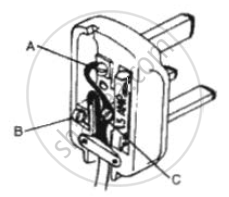
- Identify each of the colour coded wires by stating to which of the
terminals A, B or C in the diagram they should be connected. - Identify the terminal through which no current passes in normal
circumstances. - What is the purpose of the earthed wire connected to an electric
appliance like an electric heater? Describe how it works.
Electrical power P is given by the expression P = (Q × V) ÷ time
(a) What do the symbols Q and V represent?
(b) Express the power P in terms of current and resistance explaining the meanings of symbols used there in.
Define the term kilowatt - hour and state its value in S.I. unit.
An electric bulb is marked '100 W, 250 V'. What information does this convey?
Electrons in a conductor move from:
