Advertisements
Advertisements
Question
Advertisements
Solution
APPEARS IN
RELATED QUESTIONS
Explain why, the core of an electromagnet should be of soft iron and not of steel.
What condition is necessary for the production of current by electromagnetic induction?
Describe one experiment to demonstrate the phenomenon of electromagnetic induction.
Calculate the dimensions of (a) \[\int \overrightarrow{E} . d \overrightarrow{l,}\] (b) vBl and (c) \[\frac{d \Phi_B}{dt}.\] The symbols have their usual meaning.
The diagram 10 shows two coils X and Y. The coil X is connected to a battery S and a key K. The coil Y is connected to a galvanometer G.
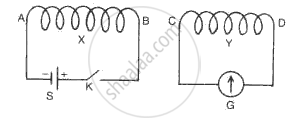
When the key K is closed. State the polarity
(i)At the end of the coil X,
(ii)At the end C of the coil Y,
(iii)At the end C of the coil Y if the coil Y is (a) Moved towards the coil X, (b) Moved away from the coil X.
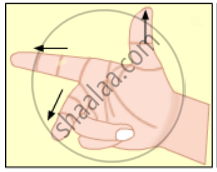
Name the following diagram and explain the concept behind it.
State the condition at which we say the two coils kept close to each other are perfectly coupled with each other.
A square coil of side 30 cm with 500 turns is kept in a uniform magnetic field of 0.4 T. The plane of the coil is inclined at an angle of 30° to the field. Calculate the magnetic flux through the coil.
An induced current of 2.5 mA flows through a single conductor of resistance 100 Ω. Find out the rate at which the magnetic flux is cut by the conductor.
When an electric current is passed through a wire or a coil, a magnetic field is produced. Is the reverse phenomenon possible i.e, can a magnetic field produce an electric current? Explain with the help of an appropriate example.
