Advertisements
Advertisements
Question
Advertisements
Solution
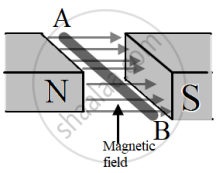
(i) Fleming's left hand rule is used to find out the direction of Lorentz force on a conductor. (ii) Fleming's right hand rule is used to find out the direction of induced current in a conductor.
APPEARS IN
RELATED QUESTIONS
Which of the following correctly describes the magnetic field near a long straight wire?
Name the rule for finding the direction of magnetic field produced by a straight current-carrying conductor.
What is the shape of a current-carrying conductor whose magnetic field pattern resembles that of a bar magnet?
The diagram given below represents magnetic field caused by a current-carrying conductor which is:

(a) a long straight wire
(b) a circular coil
(c) a solenoid
(d) a short straight wire
Two coils A and B of insulated wire are kept close to each other. Coil A is connected to a galvanometer while coil B is connected to a battery through a key. What would happen if:
the current is stopped by removing the plug from the key?
Explain your answer mentioning the name of the phenomenon involved.
Name three factors on which the magnitude of force on a current carrying conductor placed in a magnetic field depends and state how does the force depend on the factors stated by you.
State condition when magnitude of force on a current carrying conductor placed in a magnetic field is maximum?
The strength of magnetic field around a current-carrying conductor is ____________.
A magnetic field directed in north direction acts on an electron moving in east direction. The magnetic force on the electron will act ____________.
The diagram below shows a free conductor AB is kept in a magnetic field and is carrying current from A to B. (To avoid confusion complete path of the circuit is not shown) The direction of the force experienced by the conductor will be: