Advertisements
Advertisements
प्रश्न
Advertisements
उत्तर
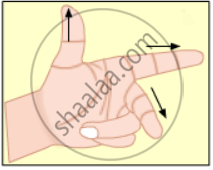
(i) Fleming's left hand rule is used to find out the direction of Lorentz force on a conductor. (ii) Fleming's right hand rule is used to find out the direction of induced current in a conductor.
APPEARS IN
संबंधित प्रश्न
The magnetic field inside a long straight solenoid-carrying current ______.
State whether the following statement is true or false
The field at the centre of a long circular coil carrying current will be parallel straight lines.
When is the force experienced by a current-carrying conductor placed in a magnetic field largest?
Imagine that you are sitting in a chamber with your back to one wall. An electron beam, moving horizontally from back wall towards the front wall, is deflected by a strong magnetic field to your right side. What is the direction of magnetic field?
State the form of magnetic field lines around a straight current-carrying conductor.
What type of core should be put inside a current-carrying solenoid to make an electromagnet?
The force experienced by a current-carrying conductor placed in a magnetic field is the largest when the angle between the conductor and the magnetic field is:
45°
60°
90°
180°
In the simple electric motor of figure given below, the coil rotates anticlockwise as seen by the eye from the position X when current flows in the coil
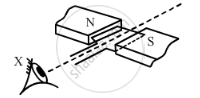
Is the current flowing clockwise or anticlockwise around the coil when viewed from above?
Name the following diagram and explain the concept behind it.
Which of the following pattern correctly describes the magnetic field around a long straight wire carrying current?
