Advertisements
Advertisements
Question
Ten bulbs are connected in a series circuit to a power supply line. Ten identical bulbs are connected in a parallel circuit to an identical power supply line.
(d) Which circuit would have less current in it?
Advertisements
Solution
(d) Series circuit
RELATED QUESTIONS
What is an Ammeter? How is It Connected in a Circuit? Draw a Diagram to Illustrate Your Answer.
In 10 s, a charge of 25 C leaves a battery, and 200 J of energy are delivered to an outside circuit as a result.
- What is the p.d. across the battery?
- What current flows from the battery?
One coulomb of charge flows through any cross-section of a conductor in 1 second. What is the current flowing through the conductor?
What is the conventional direction of the flow of electric current? How does it differ from the direction of flow electrons?
Which unit could be used to measure current?
(a) Watt
(b) Coulomb
(c) Volt
(d) Ampere
V1, V2 and V3 are the p.ds. across the 1Ω, 2Ω and 3Ω resistors in the following diagram, and the current is 5 A.
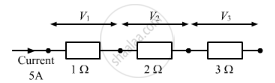
Which one of the columns (a) to (d) shows the correct values of V1, V2 and V3measured in volts?
`V_1` `V_2` `V_3`
(a) 1.0 2.0 3.0
(b) 5.0 10.0 15.0
(c) 5.0 2.5 1.6
(d) 4.0 4.0 2.0
Consider the circuit given below:
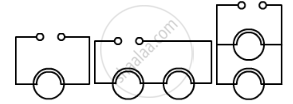
(a) In which circuit are the lamps dimmest?
(b) In which circuit or circuits are the lamps of equal brightness to the lamps in circuit (i)?
(c) Which circuit gives out the maximum light?
Define the following:
Electromotive force
A charge of 80 C flows in a conductor for 2 minutes.
(a) Calculate the current flowing through the conductor.
(b) If the current through a heater is 4 A what charge must be passing in 8 seconds?
Name the principle on which a transformer works.
What is meant by internal resistance of a cell?
The power of an electric device is a product of ______ and ______.
Match the items in column-I to the items in column-II:
| Column - I | Column - II |
| (i) electric current | (a) volt |
| (ii) potential difference | (b) ohm meter |
| (iii) specific resistance | (c) watt |
| (iv) Electrical power | (d) joule |
| (v) electrical energy | (e) ampere |
