Advertisements
Advertisements
प्रश्न
If a charge of 420 C flows through a conducting wire in 5 minutes what is the value of the current?
Advertisements
उत्तर
The current flowing through the conducting wire is
`"I" = "Charge (Q)"/"Time (t)"`
⇒ `"I" = 420/(5 xx 60) = 1.4 "A"`
Hence, the current flowing through the wire is 1.4 A.
APPEARS IN
संबंधित प्रश्न
What Makes an Electric Current Flow in a Wire?
A p.d. of 6 V is applied to two resistors of 3 Ω and 6 Ω connected in parallel. Calculate:
(a) the combined resistance
(b) the current flowing in the main circuit
(c) the current flowing in the 3 Ω resistor.
You can given one hundred 1 Ω resistors. What is the smallest and largest resistance you can make in a circuit using these?
Give three reasons why different electrical appliances in a domestic circuit are connected in parallel.
The lamps in a house hold circuit are connected in parallel because:
(a) this way they required less current
(b) if one lamp fails the others remain lit
(c) this way they require less power
(d) if one lamp fails the other also fail
Distinguish between an open and a closed circuit.
Complete the following sentence:
A fuse is connected in ........... with the ......... wire.
Tick(✓) the correct choice in the following:
24 watt, 12 volt head lamp is fully lit by connecting it to a 12 volt
battery. The working resistance of the lamp is
Find the effective resistance in the following circuit diagrams (Fig.):
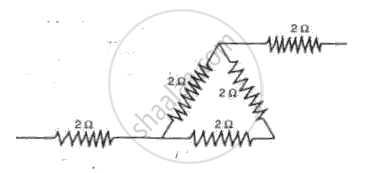
Fig . shows the core of a transformer and i ts input and output connections
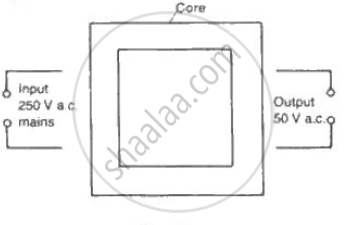
State the material used for the core and describe th e structure of the core.
(a) Use the values given in the diagram to calculate the turns ratio for the transformer and connections, labeling all parts of the diagram .
(b) If a current of 2 A is taken from th e output, calculate th e current in the input circuit (Assume the transformer to be ideal ).
A current of 0.2 A flows through a wire whose ends are at a potential difference of 15 V. Calculate:
(i) The resistance of the wire, and
(ii) The heat energy produced in 1 minute.
A bulb is connected to a battery of p.d. 4 V and internal resistance 2.5 Ω . A steady current of 0.5 A flows through the circuit. Calculate:
The energy dissipated in the bulb in 10 minutes.
MCB is used to protect household electrical appliances.
Name any two devices, which are working on the heating effect of the electric current.
A current of 2A passing through the conductor produces 80 J of heat in 10 seconds. The resistance of the conductor is ______.
Electric current passes through a metallic conductor due to the movement of ______.
