Advertisements
Advertisements
प्रश्न
What Makes an Electric Current Flow in a Wire?
Advertisements
उत्तर
The potential difference between the ends of the wire makes the current flow through the wire.
APPEARS IN
संबंधित प्रश्न
Choose the correct alternative and rewrite the following sentence.
When the resistance of a conductor increases, the current will ________ increase.
In 10 s, charge of 25 C leaves a battery, and 200 J of energy are delivered to an outside circuit a result.
What current flows from the battery?
A battery of 9 V is connected in series with resistors of 0.2 Ω, 0.3 Ω, 0.4 Ω, 0.5 Ω and 12 Ω. How much current would flow through the 12 Ω resistor?
In the circuit diagram given below, three resistors R1, R2, and R3 of 5 Ω, 10 Ω and 30 Ω, respectively are connected as shown
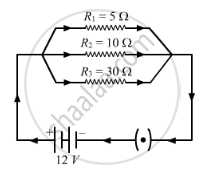
Calculate:
- current through each resistor.
- total current in the circuit.
- total resistance in the circuit.
Ten bulbs are connected in a series circuit to a power supply line. Ten identical bulbs are connected in a parallel circuit to an identical power supply line.
(b) In which circuit, if one bulbs be brighter?
In the network shown in the following adjacent Figure, calculate the equivalent resistance between the points.
- A and B
- A and C

Distinguish between an open and a closed circuit.
Tell the odd one out. Give a proper explanation.
Define the following:
Semiconductors
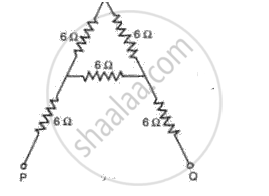
Find the effective resistance in the following circuit diagrams (Fig.):
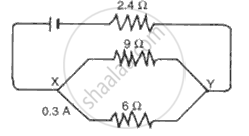
A current of 0.3 A is flowing through a branch of 6 Ω resistors in a junction as shown in fig. . Calculate the
(a) P.d. across the junction XY,
(b) Current flowing through 9Ω and 24Ω
( c) P.d. across 24 Ω resistor, and
( d) e.m.f. of the cell.
What is the purpose of a fuse in an electrical circuit?
An electric bulb is rated at 220 V, 100 W.
- What is its resistance?
- What safe current can be passed through it?
A bulb marked 12 V, 24 W operates on a 12 V battery for 20 minutes. Calculate:
- The current flowing through it, and
- The energy consumed.
How is direction of current related to the direction of flow of electrons?
Which of the following represents voltage?
The relationship between conventional current and electron flow is that they are:
Common sources of Direct Current (DC) are:
