Advertisements
Advertisements
Question
If a charge of 420 C flows through a conducting wire in 5 minutes what is the value of the current?
Advertisements
Solution
The current flowing through the conducting wire is
`"I" = "Charge (Q)"/"Time (t)"`
⇒ `"I" = 420/(5 xx 60) = 1.4 "A"`
Hence, the current flowing through the wire is 1.4 A.
APPEARS IN
RELATED QUESTIONS
The work done in moving a unit charge across two points in an electric circuit is a measure of ______.
Which of the two is connected in series : ammeter or voltmeter?
In 10 s, charge of 25 C leaves a battery, and 200 J of energy are delivered to an outside circuit a result.
What current flows from the battery?
One coulomb of charge flows through any cross-section of a conductor in 1 second. What is the current flowing through the conductor?
Which effect of current is utilised in the working of an electric fuse?
State the S.I. unit of current.
Tick(✓) the correct choice in the following:
When the length of a conductor is doubled the resistance of the conductor
will
Find the effective resistance in the following circuit diagrams (Fig.):
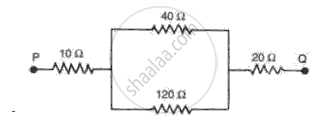
Find the effective resistance in the following circuit diagrams (Fig.):
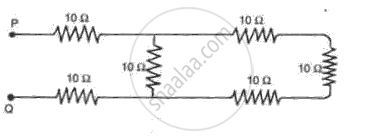
Three heaters each rated 250 W, 100 V are connected in parallel to a 100 V supply of the energy supplied in kWh to the three heaters in 5 hours.
An electric kettle is rated 2.5 kW, 250 V. Find the cost of running the kettle for two hours at Rs. 5.40 per unit.
Answer the following question.
An electric lamp of resistance 20 Ω and a conductor of resistance 4 0 are connected to a 6 V battery as shown in the circuit. Calculate: 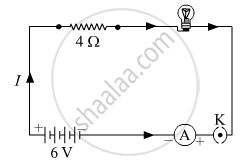
(a) the total resistance of the circuit,
(b) the current through the circuit,
(c) the potential difference across the (i) electric lamp and (ii) conductor, and
(d) power of the lamp.
Explain, why the potential difference across the terminals of a cell is more when the cell is not in use than it is when the cell is being used.
Kilowatt hour is the unit of
Problems for practice:
If 5A current flows through a circuit, then convert the current in terms of microampere?
Match the items in column-I to the items in column-II:
| Column - I | Column - II |
| (i) electric current | (a) volt |
| (ii) potential difference | (b) ohm meter |
| (iii) specific resistance | (c) watt |
| (iv) Electrical power | (d) joule |
| (v) electrical energy | (e) ampere |
By convention, the direction of electric current in the external circuit is taken as:
A charge of 20 C flows through a conductor in 4 s. The electric current through the conductor is:
