Advertisements
Advertisements
प्रश्न
The lamps in a house hold circuit are connected in parallel because:
(a) this way they required less current
(b) if one lamp fails the others remain lit
(c) this way they require less power
(d) if one lamp fails the other also fail
Advertisements
उत्तर
(b) If one lamp fails, the others remain lit.
This is so because in a parallel circuit, if one device fails, it does not affect the working of the other devices.
APPEARS IN
संबंधित प्रश्न
<p> Define the unit of electric current (or Define ampere).
Which instrument is used to measure electric current? How should it be connected in a circuit?
If the amount of electric charge passing through a conductor in 10 minutes is 300 C, the current flowing is:
(a) 30 A
(b) 0.3 A
(c) 0.5 A
(d) 5 A
The circuit diagram given below shows the combination of three resistors R1, R2 and R3:
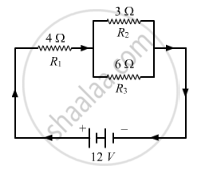
Find :
(i) total resistance of the circuit.
(ii) total current flowing in the circuit.
(iii) the potential difference across R1.
Consider the circuit given below:
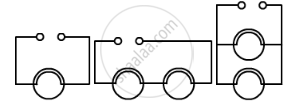
(a) In which circuit are the lamps dimmest?
(b) In which circuit or circuits are the lamps of equal brightness to the lamps in circuit (i)?
(c) Which circuit gives out the maximum light?
Draw a circuit diagram showing two electric lamps connected in parallel together with a cell and a switch that works both lamps. Mark an â’¶ on your diagram to show where an ammeter should be placed to measure the current.
Consider the circuit given below when A, B and C are three identical light bulbs of constant resistance. 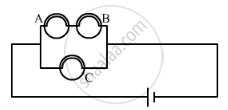
(a) List the bulbs in order of increasing brightness.
(b) If C burns out, what will be the brightness of A now compared with before?
(c) If B burns out instead, what will be the brightness of A and C compared with before?
Two resistors of 2.0 Ω and 3.0 Ω are connected (a) in series (b) in parallel, with a battery of 6.0 V and negligible internal resistance. For each case draw a circuit diagram and calculate the current through the battery.
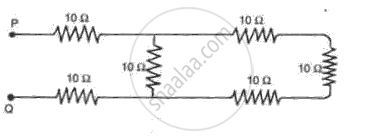
Find the effective resistance in the following circuit diagrams (Fig.):
What would be the danger involved in replacing a blown fuse with the one which would carry a large current?
What is the function of a step-up transformer?
What should I choose ___________________
b. for getting protection from electric current.
c. to measure the current in the circuit?
My mother was operating washing machine on Sunday morning. Suddenly, she saw a spark coming out of the electric board and the electric current in the house failed. An electrician was called to look into the matter. What should he have noticed.
State expression for Cells connected in series.
State the condition when it is advantageous to connect cells in series.
Small amounts of electrical current are measured in milliampere (mA). How many milliampere are there in 0.25 A ?
State whether true or false. If false, correct the statement.
Current can produce magnetic field.
In a vacuum, the particles that can act as charge carriers are:
